It is a CRIME that I haven’t written on this blog one time this year. It’s a crime that you haven’t heard from me and that I haven’t asked how you’re doing.
So I’m correcting all that now. How are you? Me? I’m like a puppy swimming for the first time — I’m just trying to keep my head above water.
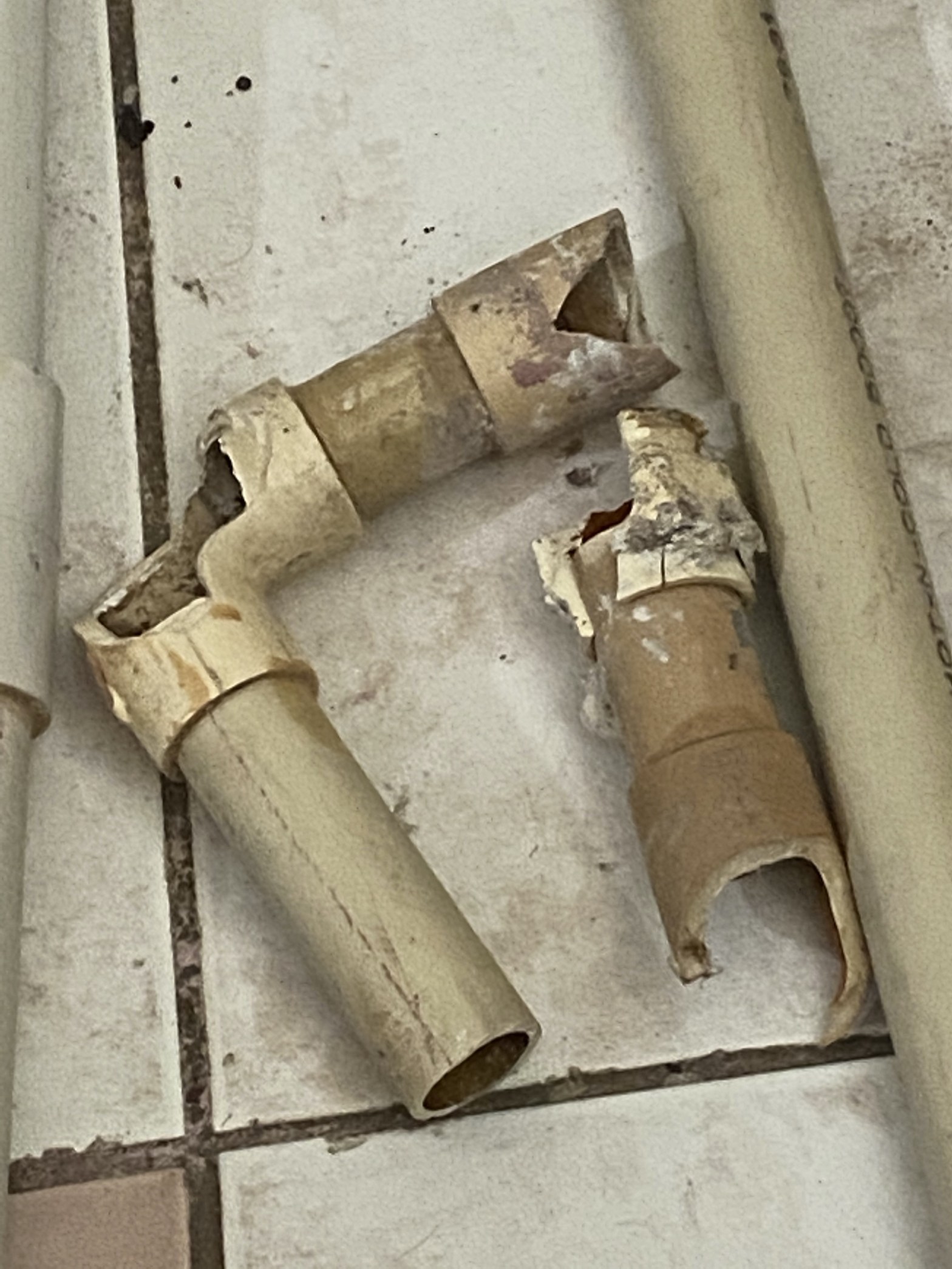
The pandemic and all it’s aftermath has been challenging to maneuver to say the least but add to that the deep freeze Texas just went through, I almost broke. And so did my water pipes (picture above are what the pipes looked like). It took two weeks after the freeze to get running water in back in the house. In those two weeks I have carried countless buckets of water from a temporary faucet created by the plumber into the house for cooking, bathing, and toilet flushing. If it weren’t for the summers growing up in a small village in Guatemala, I don’t think I would have done as well as I did.
And yet, I’m here on a lovely Saturday afternoon not really wanting to do nothing more than watch movies all day.
That’s what I’m going to do, watch movies all day.
In a nutshell, that is what this pandemic and this winter storm aftermath has been, giving myself permission for so many things. This is a difficult thing for an overachiever, which I consider myself to be but only as a coping mechanism. Growing up in East Harris county in the 80s and being one of the few family of color in a very white and (back then) somewhat affluent neighborhood, you had to over perform and be greater than your counterpart to even be considered. Sometimes you didn’t to do that just to be allowed in the room.
That overachieving continued through most of my life and lead me to enter the competitive sport that is American journalism. And, well, everything went downhill from there.
I don’t know how to switch this thing off now. The pandemic has forced me to learn to switch off the overachieving, the performance I have done for so long. I don’t know how to sit with it, what it means to not perform it and be still. I’m having problems with that, the stillness of it all.
What happens to a performer when the performance ends?
I don’t know the answer to that question. Wish I did.
I have been running. Literally. Mostly for health because of a health scare but my mind redirects when my feet hit the track. It focuses on one thing — getting through the run. It fights with itself and the battle is between the part of my brain that doesn’t think it can go on vs the part that knows it can. I don’t know who will win from run to run. Some runs are perfect. Other runs are tragedies. What they all have in common is that there is no performance, there is no thinking about the pandemic, there is no thinking about how I’m not living to my potential or my dreams at the moment.
Me after one of my runs.
In effect, the judgement ceases and it’s all about surviving the run.
It’s not about pipes bursting.
It’s not about not having water.
It’s not about how tired I am of working from home.
It’s about finishing this run, as best I can.
It’s about looking forward and running toward the end of this race.
I don’t know when all this is going to end, despite herd immunity. I don’t know what the lessons are that we will collectively learn. But I know that today, I’m going to watch movies, maybe take our new dog (we brought in a stray before the freeze) for a walk later, and attempt to understand this stillness.
I’ve been doing research for my next writing class — the Happiness Practice.
It’s my most ambitious creative writing class yet! Not only am I creating prompts and the creative writing materials, I’m also based it on something that, I think, people want — to be happy.
I’ve been reading some materials lately. It started with a basic Google search — as everything does. Here’s what found from that search and the link to them:
I’m learning so much and sharing what I’m learning as well as my notes on Twitter under that #happinesspractice
Also, genuine compassion and generosity are paths to happiness. Internal work that has external actions. I think that in this way, happiness is also spread, if, indeed, we are hardwired for generosity.
So far, compassion and generosity have come up for happiness as paths or necessities to true happiness, not temporary or “selfish happiness”.
And that has been mind opening. This idea that happiness not only comes from within but that the work toward it, the practice of it, begins with understanding compassion and generosity.
That is what makes it hard. Because some of that compassion and generosity is also for one’s self. No, that’s not selfish that is the first step. Learning compassion for yourself, giving yourself grace, makes it easier to have compassion for other people. To be generous with your time and effort and, yes, sometimes your money.
I have also learned that research shows we may be hardwired to be generous!
(4/4)
"There was strong and compelling research that we come factory equipped for cooperation, compassion, and generosity."
Generosity as a part of our brain circuitry? That blew me away. And as a writer and creative, I’m wondering if that is why we are drawn to it, to be generous with our gift of art.
Lots to think about and ponder!
I am so excited about this writing class. And THAT brings me happiness.
I’m expecting another Biblical event happening any day now. I mean, it IS hurricane season and what’s to stop this crazy year from unleashing something we didn’t expect?
Build was chosen because I wanted to create some things for future years. I wanted to learn and unlearn things than no longer served me. Boy, ain’t that happening this year!
For build, I wanted to concentrate on four areas: health, creative, financial, and family/community.
At first, I was afraid that I hadn’t done much with my word. Frankly, I was more focused on survival. But when I went back to reflect, I was pleasantly surprised.
For health, I have been working on not only being physically stronger but mentally stronger, focusing on finding as much time as I could for myself while giving myself grace for not accomplishing things. If I couldn’t complete something on my to do list, for example, I gave myself permission to rest. I repeated a mantra, “it will get done” and somehow, magically, it did.
I also worked out. Yes, I’m still working out. I temporarily stopped during what I call AllergyGate 2020. (Did you know you can get several allergies at the same time during a pandemic?) Now, I’m easing back into my workout routine. This pleases me to no end.
I am learning how much my body loves to move. This is my favorite yoga mat. Yes, I do have a favorite. Yoga gives me comfort. I’m also enjoying tabata workouts as well.
For my creative goal, I thought that I needed to complete projects or add more to fulfill my word of the year. Yes and no. While I’m working on my memoir, of course, it’s important to send out work into the world and share. I not only want to build myself up as a creative but give back to other creatives. Hence the workshop this week. I have others that I am planning as well, including a short practice in September.
Build also means that my creative projects have gotten deeper and more purposeful. For example, the second season of Dear Reader is something I’m already proud of. The writers and guests on the show are brilliant and I think there will be opportunity to learn from them.
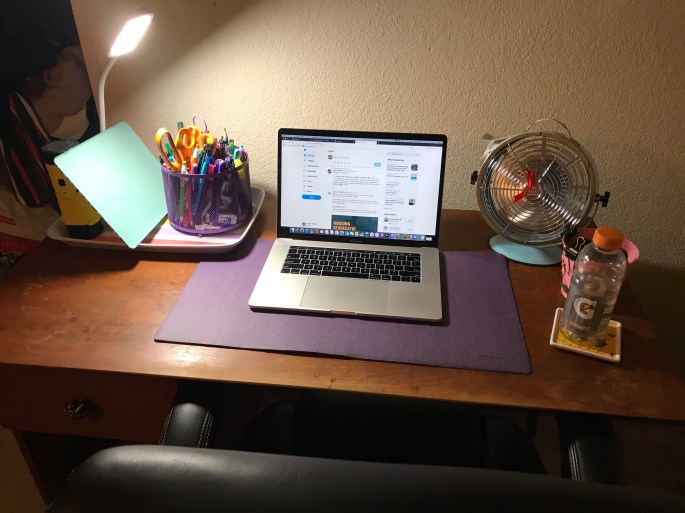
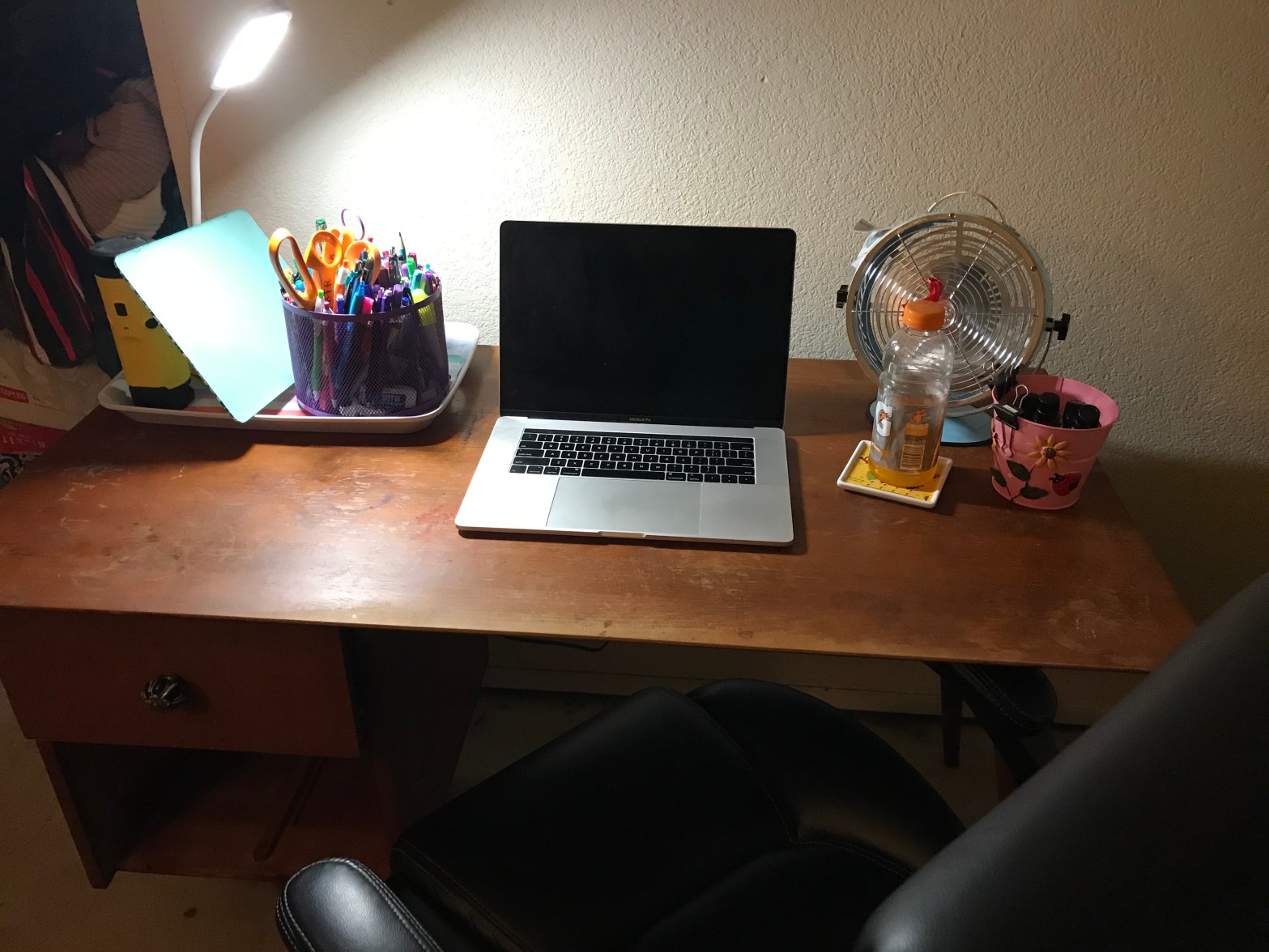
Part of building was also building a space for my work. That meant recovering my desk from storage, cleaning out a room in my house and putting together my office.
Among all these areas, financial has been the most surprising. I thought build meant making more money. But what has been interesting has been learning the management of money — budgeting, investments, etc. Learning all this has been so interesting, but what has been even more interesting is to learn how money can function.
There’s so much more to share but I don’t want this to become a list. What I do want this to be is inspiration to look at your word of the year and see how your life has changed with that word, or maybe not. Maybe it’s a time of reflection to see how, for the rest of this year, you can keep the promise to yourself for the next couple of months.
I am so excited about the summer. With all my academic work done until August, I have some time to work on some projects I’ve been neglecting for awhile.
Of course that means my writing projects. Oh, my writing projects. How I have missed them!
So, here’s my latest project that I hope that you’ll participate in.
Don’t you just love magical realism?
I am hosting a free, online generative workshop called (Re)Discovering the Magic in the Realism. The theme, in case you couldn’t guess, is magical realism.
I LOVE MAGICAL REALISM!
I didn’t know that how my father told me stories and talked about Cuba was magical realism. Also, I didn’t know until I had to teach magical realism to my students that the phrase was coined by Cuban novelist Alejo Carpentier in 1949.
That piece of information made me feel like a million bucks! (In case you didn’t know, I’m half Cuban from my dad)..
Magical realism is:
enriches the idea of the “real” by incorporating all dimensions of the imagination, including magic, myth, and religion.
magic realism features ordinary characters who undergo supernatural experiences. This is an unconventional way of telling stories.
And, you’ve already experienced magical realism in movies. Yes, remember this scene from American Beauty?
Or… remember this?
Magical realism is exactly that, a magic that is embedded into the reality of the world. It’s a different way of looking at things and, I find, that it’s ingrained in hope.
Want to take the workshop? Sign up by clicking the button below.
However, conventional thought and theory says I should hate this holiday at or more than the level of my rancor for Columbus Day. But… I don’t.
I don’t hate July 4. I want to celebrate my country.
And that is a feeling that is difficult to reconcile because what exactly am I celebrating? The death and massacre of black men and women and other people of color? The continued systemic racism and how fermented and embedded it is in everyday life? The vitriol against pretty much everyone I know — people of color, immigrants, LGBTQ+, etc? The public discourse that is so toxic you can almost light it with a match?
I don’t want to celebrate these things. I also don’t want to celebrate false history.
The founding fathers? Most of them were slave holders. And while they were in a position to end slavery early on, they didn’t. Washington had a set of dentures made from, among other things, the teeth of his slaves. Jefferson raped Sally Hemmings and fathered several children. Others enabled this behavior or mimicked it.
And yes, these men were brilliant in their own way. Morally suspect? Absolutely.
But I still want to celebrate 1776 even though not everyone was free at the end of the Revolutionary War.
I still want to celebrate a country that gave my immigrant parents an opportunity to live and prosper even though it conspired to make them fail.
I want to celebrate a government that is, in theory, for the people but in practice is for the dynasties with the most money.
I want to celebrate the Bill of Rights and the amendments even though I know they were not originally made for me.
I want to love my country even though I scorn it because I know it can be better for everyone. Damn it, I believe in the American promise even though the promise is a lie.
That is why today I am so conflicted. That’s why today I don’t know what to do, celebrate or consider it like any other day. It’s much more difficult this year to celebrate than it was last year. I can’t even find the joy in it.
This dichotomy is bothering me like that nagging feeling that you’ve forgotten something. I can’t shake it. This internal American conflict. I can’t loosen its grip and so, here I am doing what I usually do in these situations, writing to understand why.
And here I am close to the end, no closer to a solution than when I began.
Maybe that is America, this country I love but a country that doesn’t love me back. It’s complex and challenging and a contradiction. So many contradictions that it reminds me of a Molly Ivins quote about another institution that also conflicts me.
“I don’t mind so much that newspapers are dying — it’s watching them commit suicide that pisses me off.”
I don’t mind so much that my country is challenging – it’s watching it self-inflict a million cuts is what infuriates me.
Infuriate. Is what I am feeling a form of anger? Maybe. Or maybe what I’m feeling is the stages of grief. Last year was denial and this year it’s anger.
If this is true, if this contradictory feeling in my chest is part of a process, eventually there will be acceptance.
I can’t even imagine what that will feel like. Just the thought of it infuriates me. But then again, that maybe what is making this year tougher than last year, the anxiety of what acceptance will look like.
With all that is going on with the world at the moment — pandemic, racism, homophobia, xenophobia, and the like — its the worst time to lose an activist, especially one who has been working toward the betterment of people for most of his life.
But the death of Macario Ramirez is a reminder that despite the fight, life continues and that we are, despite how we treat each other, human. And humans don’t last forever.
I wish men like Mr. Ramirez did. I wish that he could have seen the fruits of his activism, all the way to the full equality of people. I also wish that the fight for said equality wasn’t something that is inherited from one generation to another like a bad debt that will never be repaid.
Talking about debt, how can we repay a man like Mr. Ramirez?
Let me attempt to start with this post, these thoughts, which are dedicated to him and his life as he has dedicated so much of his life to us.
Like when the Hispanic community needed someone to speak up, his voice was always the loudest.
Like how his store, Case Ramirez in Houston’s Heights neighborhood, was an opportunity to put down roots, our way, when it was too easy for others to uproot us.
Like how he reminded us every year that we are nothing without our ancestors. That la lucha is nothing without the permission, the help, and the guidance of nuestros ante-pasados.
It is here that I share how he showed me to be an activist in the best way and the most effective way I can.
I am blessed to have lots of feathers in my cap, but one of the ones I am most proud of is being the first on my campus to teach Mexican American Literature.
This was just an awesome opportunity. Growing up in Houston and in the literary community here, I had a front seat to real life Mexican American Literature. I feel the heartbeat, the muscles as they flexed and expanded. I don’t study Mexican American Literature, I inhale it. There is no other way.
So when it was time to show my students what was Mexican American Literature and culture, I turned to Ramirez. No brainer.
Imagine an Afro-Latina with Cuban and Guatemala roots showing students about Mexican American culture. Even I can see the irony and even I could see that I knew just enough to know I didn’t know everything. That’s why the field trip to his store for Dia de los Muertos.
While my family culturally doesn’t directly observe this holiday, we do have alters to our ancestors but none as beautiful and intricate as those at Case Ramirez. Students saw a procession of Aztec dancers in full traditional dress and then walked through the store, awing and being inspired by the floor to ceiling alters and ofrendas.
We passed by him and I said hello. I may have introduced him to my students. At that point he was sitting on a stool, beaming at the people coming into his shop.
The next year, the students’ schedule wouldn’t coordinate to do another field trip so I gave them extra credit to take an alter-making class with Mr. Ramirez. I had more Mexican American students in the class this time. One of them came back and told me how she never felt so connected to her culture than she was in my class. That taking the class with Ramirez made her feel seen in a way she didn’t know she needed to be seen. She started her own alter and thus a new tradition for her family.
For me, as a professor, it was a reminder of how important it was to be all present with my full self to my students. As a person who cares about humanity, this was how I learned that knowledge is a gift. This was how activism could be, a gift.
I suspect Mr. Ramirez has heard this story over and over again. Because, despite all the activism done through his lifetime, this seemingly simple thing — the re-connection to ancestors through ofrendas — is a large part of his legacy.
Yes, while we inherit la lucha, we inherit this too: tradition, connection, roots. A center. A peace. Knowledge that we are not alone and that we continue through the love and memories of those we leave behind.
Rest, Mr. Ramirez. You taught us well. Thank you for the inheritance. We will continue on.
It’s been a rough couple of weeks. The pandemic seems like child’s play compared to the continuous killing of black men and women.
The burden of that. The action of that. The broadcasting of that. All of it wears on me like a stone. Between that and other things I finally broke down in front of my therapist today.
“I am exhausted,” I cried.
“I can see it. It’s all over your face.”
Frankly, it’s been all over my face for weeks, maybe even months. The best thing about this pandemic is that I can keep my exhausted face away from everyone and stay in the safety of my exhaustion while I work toward not being exhausted.
That’s probably not healthy but I’m too exhausted to care.
Anti-blackness, racism, and all of it is something that is so much apart of my life, I sometimes don’t notice how much it burdens me. I’m use to carrying that load. And I only realize I am carrying that load when I enter the room filled with other black people. An armor lifts. Breathing is easier, less labored and purposeful. I relax. Relax. Relax. Rest, if only for a bit.
And that is a spot of joy. That is enough for me to pick up my armor at the end of the night and return to a world that continues to find ways to remind me to stay in my place.
Journalism was like this. Newsrooms were like this. How I survived that long was mind boggling.
So, among all this pain, and the crying I did during my session, there was a bit of joy.
My desk, the one that has been with me since my tour of duty in Corpus Christi in 2004, is finally in my home and in the room that is slowly being converted into my home office.
My desk. My home office. My home.
This is where I breathe out.
There is a freedom in words, one that has always called to me. It has become my calm in the center of a storm, the way I understand the world, how I interact, how I chastise it for not living up to its promise.
But I’m not chastising now. I’m exhausted, remember?
And my desk? She is my heaven. My gateway to freedom. And tonight, she is my spot of joy.
It’s something so simple and for the average person it is a piece of furniture in a room in a house.
How dare we, however, over look joy in moment of simplicity if that is where joy calls home. Joy is simple and clean and there. Joy is there and I want to grab it with both hands when it comes.
Like when I take off my armor in a room full of black people.
Like when I cry during my therapy session.
Like when I can say I am exhausted and it is accepted and acknowledged.
Like when I can claim a space that is mine.
Like when I am seen, truly seen, and loved all the more.
For this morning’s post, I am addressing it to my fellow academics. My fellow friends in arms who have suddenly been told they will have to take their class online.
And they are in panic mode.
So for them, I have thoughts and ideas. Also some advice. So Reader, all of you, if you wanted to read something bookish I will have something soon. I’m working on something from AWP. But for today, let us sooth the panic.
Dear Professors, Instructors, and other Academics who have to put an online class together almost overnight,
Let me start off by saying your panic is warranted. This sucks. OMG! But, trust me when I say this, it will be okay. Completely okay. Some background:
It was 2017 and the fall semester was days away from starting. Off the coast of Texas Hurricane Harvey brewed like a tumor. When it came on to the coast, it dumped water for days.
It also damaged the sewage treatment plant up stream from my campus.
Seven of our nine buildings were down, washed with the toxic sluge from floodwater plus sewage treatment plant water. So many of my fellow coworkers were flooded out. And a large population of our students were living with their families in hotel rooms.
We went online instantly. We had three weeks (a luxury I know) to get ready including certification and learning a management system that few of us even knew existed.
So hear me when I say…I get it.
Let me also say, there is nothing like a face to face class. And I will argue that you can’t directly translate a face to face class to online. Both are different animals. Similarities? Some. But not not enough to replace one with the other.
Also, two different types of students and learning modalities. So keep that in mind.
Here is how you get started. Kamikaze designing 101. Let’s go!
Take Inventory
What are you actually working on? What is your learning management system? What bells and whistles do they have? How long does administration expect to be online? A couple of weeks? Months? The rest of the semester? Which students have access to internet, computers, phone/tablets? Which don’t? What is the plan for them? Does email work better for them?
What resources do YOU have access to that can make the work easier?
The answer to these questions and so many more will help you immensely when designing your course.
Here’s an example:
The learning management system (LMS) we use on my campus is Brightspace/D2L. Embedded in the LMS is WebEx. It allows us to have a livestream class or do virtual office hours with students all from their LMS so they don’t have to go anywhere.
Here’s another example:
I needed to learn what students had access to after the flood. I did a Google Form to learn things about my students (You can do this with OneDrive as well). What was surprising and what I learned by doing this was that most of them had what they needed to be successful in class (in terms of equipment) and what online form they thought they best learned in. That helped me with deciding what to do going forward.
Another thing that you want to know: Does your LMS have an app for both Apple and Android? If yes, tell your students to download it. Give them bonus points for it. That’s the best and quickest way to get them information. For the Brightspace/D2L LMS, when you post an announcement they get notified just like a text. That’s huge if you want to, I don’t know, remind them they actually have work to do.
Buy yourself some time and organize
So the quickest turn around to convert to online I saw was three days. The longest was two weeks.
There is a big difference between two weeks and three days.
Huge! But not in the way you think.
If you have a quick turn around time, here is how you buy yourself time. Post a quick assignment for the students can do. It can be a quick survey or a writing assignment or a discussion board assignment. Something low stakes. Maybe do an online scavenger hunt! Have that due by the end of the week (whatever your week is). While they are completing that assignment(s), you are designing the next two weeks worth of work.
Done.
Here’s the thing, you’re going to lose a week of instruction (depending on the assignment) but doing this does a couple of things.
1.) Gives you some breathing room to make more decisions on what you’re going to do going forward. Hey, you maybe able to make up for the lost week.
2.) Gets students familiar with the LMS which should avoid problems later (some problems).
You’ll need this time to decide how you want to organize the class. By this I mean, how do you want the modules to be organized and how long you want them to be. What are modules? Here’s a good video that can explain it especially for you Blackboard folks.
For example: I organize my modules with weekly deadlines. Everything is due on the same day for consistency — Sunday 11:59 p.m. My weekly modules opens on Mondays at midnight. I do this for several reasons:
Based on my survey I know students work so they need that extra time.
Based on past classes and when students sign in (you can check this in your LMS), they do their work late at night (probably because they work)
Based on past classes, there will always be some who turn in things early. They usually get graded first.
This helps my grading schedule (For me, discussion boards are generally graded Monday mornings.)
I’ve seen others put things due through out the week. There are some advantages to that as well. It depends how you want to handle things like grading and interactions. Look at how many of your classes will be going online. Think about how you want to stagger your grading. In this aspect, online is no different than face to face.
Design your module
Listen, it doesn’t matter if you are math or English or whatever, design your module. Seriously, design it.
By design, I don’t mean what it looks like. We can talk about that in a second. By design I mean what are you actually going to put in it for instruction.
If you’re doing instructional videos, a good rule of thumb is to keep them between 10 to 15 minutes. So if you have a 30 minute lecture, that’s two videos. Do you want them to take a quick quiz on the video? (quick and easy grade)
Here’s an example of how I’ve done a lesson for the Proposal Essay. Super easy, with a Powerpoint. This is the first of four videos. Each one is about 10 minutes each.
Here’s some things you want to think about:
1.) Each module should have a lesson (whether video(s), powerpoint, or audio)
2.) Each module should have a “reading” (from the textbook or from the notes you upload).
3.) A formative assessment or activity (discussion boards/ videos etc).
4.) A summative assessment (discussion boards, etc).
5.) A list of some sort that tells students what is due and when.
6.) Since you’re putting things online last minute, keep it short! Really focus on what you want them to learn and do. If you had more time, you could have them do more but since designing is a quick turn around and the learning curve is so steep, keep it simple.
Don’t worry about the toys…
Listen, when I started, I wanted to play with all the toys. All of them!
I wanted a list of websites that can help me be stronger, faster, and awesome online.
Don’t play with toys for a bit. Focus on the basics while you are learning this new world.
…but play with the toys.
Okay, but toys are fun. And when you feel you are ready and your students are ready, introduce them one at a time. Remember, there will be learning curve with each of these as well.
Here are some things I play with in my online classes. This is only a couple. There are more but don’t get bogged down with this. Use it as you need them.
It allows you to record your lecture and screen-share from the comfort of your own home. You can sign up for and record 15 minutes at a time for free. You can upload your videos to Youtube.
During the hurricane, I went ahead and paid for it. It was around the $30 mark for three years. With that you can record longer videos and have some cloud space for the videos. I also use this tool for when I’m teaching creative writing classes online.
If you want more dazzle, you can actually save videos to your desktop and use editing software like Adobe Primer or iMovie to do fade in/out and things. Note: if you don’t want to you don’t have to. This isn’t necessary, really.
Livestreaming and live webconferncing website. Listen, my campus uses WebEx but I use Zoom. Paid for a year myself I love this so much. It does screen-sharing (both the host and the participates can do this.) It also allows you to plug in your tablet to your laptop and screen share that! So, if I’m doing a live revision, I can write something on my tablet with the Apple Pencil and it will show!
This has an app and I’ve done office hours from the Cheescake Factory on the app. It’s super handy.
And for my creative writing classes, I’ve used this to do workshopping and it worked GREAT!
Another cool feature is that it records so if you’re doing a live stream or “live” class, you can post the recording to your LMS for students who missed it.
It’s been awhile since I used it but when I did I loved it. It has similar capabilities to Zoom. I did end up switching to Zoom because it was more stable but that was a couple of years ago and it may have been upgraded.
Last time I used it, it was attached to Youtube in someway. If this has changed, please let me know!
Here’s me doing a live class using Google Hangout when I went to conference. I scheduled a live stream and then put the link in the LMS for students to use. It recorded so they can access the same link to see the replay.
I LOVE this thing! A friend introduced me to this way of doing discussion boards with video and I instantly put it in my classes. You can post questions and such online and have the students answer it with a short (no more than 5 minutes) video. So if you’re doing any group critiquing or feedback, this will work. And it’s free. And it has an app. And students can use their phones.
I’ve also used this with my creative writing classes for students to read their pieces online or to give general feedback.
I like this tool to give back really quick feedback like for thesis statements and such. Or students can post their presentations there and get feedback from other students.
Here’s what I’ll say. If you are comfortable with the discussion boards, stay there. Padlet, I suggest, can be used as formative assessment and/or a way to critique things.
Spark is free to use and allows the student to create videos with voice overs to create a presentation. Each “slide” is limited to 20 seconds and the presentation can’t be more than five minutes-ish long.
I have a love/ like relationship with EdPuzzle. This site allows you to insert questions for students to answer in any Youtube video.
Hint: a formative assessment for your lessons!
It’s great because it’s embed-able to the LMS and you receive feedback on how the students did on the questions. It’s helpful to see if they saw the entire lesson and what they don’t understand because, as we all know, they don’t usually tell us.
What does irk me though is that students have to sign up for an account or use their Google email. It’s not a big thing but it can cause some confusion sometimes.
I used this to talk to students and to text students if need be. This is a good way to contact them without giving them your number. Some students will not feel comfortable with virtual office hours. This is a good alternative. And yes, there’s an app. And yes, get the app.
Consider the student
You probably haven’t noticed how I’ve organized this blog post. Go back and take a look.
I have subheds, lists, short-ish paragraphs, embedded links, Youtube videos, etc..
I do this because it’s easier to take in information in chunks. When you are designing and putting together directions, you want to look at how it’s laid out and keep information in smaller chunks.
Listen, students are going to speed read through things. They are. BUT if you have things in subhead and lists, they will get the big things and follow directions.
And, you’ll want to do a video where you show them the online class! Here’s an example of an old one from one of my comp classes.
When I redo this video next year, I’ll do it smaller chunks and by topic.
You’ll also want to do a part of your online course where you show students how to be an online student.
There are TONS of videos on Youtube about this subject. And they are done but actual online students. Here’s one.
Call in reinforcements
Listen, you’re not going to get this all right away. There is help and I have a recommendation!
Jasminne Mendez has helped teachers and professors make the switch to online for five years. She’s an instructional designer (I am not. At least not yet. Talk to me next year as I am pursuing this.) She helped me to get my online class together during the hurricane. And I go to her even now.
And heck, she may read this and have a completely different take. Like with everything else, there is more than one way to do things. The best advice for this is to go for what you can do and then grow from there.
Listen, how I designed my first class is NOTHING to how my classes are now. Give yourself credit for growing and be curious about things.
How does it all come together? Check out this video.
Welcome to Noir Week! I’m so excited to do a week of introspection on one of my favorite genres to read and to write.
For this week, I’ll write a post each day on an aspect of noir writing. All of this leads up to my online noir writing class through WriteSpace in Houston, Texas — Femme Falates, Sidekicks, and Gumshoes: A Noir Writing Workshop
A little about the online class:
The femme/homme fatale, the detective, the side kick, the villain. Sprinkle in dark, moody atmosphere, a crime, the snarky voice of a lead character–and you have the ingredients of a stellar noir story.
Noir is a mystery subgenre that has its own grime and grit. From Raymond Chandler to Jessica Jones, the genre has moved and shifted over time but one thing remains the same, you know noir when you see (or read it!). In this online course, we’ll discover what makes a noir story tick, how to flesh out the characters, and he best way to tackle place and atmosphere. By the end of our time together we’ll create our own noir stories, as dark and gritty as a dark, windless night.
Now, for today’s post, let’s talk about the least known and thought about in the noir genre.
The sidekick! They get such a bad wrap and are so under used.
In vintage noir, noir stories written or filmed during the golden era (30s and 40s), the sidekick was usually the secretary. That lonely woman who knew her detective boss better than he did and knew exactly how he liked his drink … and his women.
The sidekick could also be a reluctant friend or person that helps the main character do their job better.
With all this work that the sidekick does, you would think that this would be a more important role in a noir story. Why isn’t it.
The sidekick is a SECONDARY character.
Let’s talk about that. In short, a noir story is dark usually in its subject matter but not always. It’s a sliver of life where things are never neat. It’s where humanity shows its underbelly without abandon. That’s what makes the story dark or noir.
A sidekick can prove a big a levity but not too much. One sidekick that stands out in my reading comes from a Rachel Caine story, “Marion, Missing” from the anthology Dark Secrets: A Paranormal Noir Anthology.
In the story, Tilde, is killed and the detective, Valentine, needs to figure out a way to solve the murder of his sidekick. And she does that … as a ghost.
No one said you couldn’t cross genres.
Even as a ghost she makes sure her detective is taken care of. Here’s something from the opening scene when the reader first meets Tilde Sands.
“Really?” Tilde Sands sounded like she’d found it funny. “That’s how you’re handling it? Moping like some sad sack whose girl dumped him?”
“You weren’t my girl,” he said. “Any you haven’t dumped me. You’re still here.”
“Val,” she said, “you’ve really got ot let go of the past. Now get in here and pull some files. You like like a cliche sitting there. All you need is a half-empty bottle of cheap scotch.”
“Be fair,” he said. “I like vodka. Doesn’t leave a smell that upsets the clients.”
“Come get the files.”
In that scene, even though Tilde is dead and a ghost, she’s still keeping her detective in line. He needs focus. He’s starting to spiral. She is making sure that he continues and not taking any grief from him in the process.
A sidekick doesn’t necessarily have to be a physical person, or even a person. In modern noir stories not only can genres be crossed but noir can expand past the edge of traditional storytelling.
A more traditional example? Of course! Jessica Jones has several sidekicks even thought she prefers to work alone (they always do). In season one of the Netflix show, we see that her childhood friend Trish helps her beyond what would be considered logical. Add to her posse Malcolm Ducasse, who has his own problems that he has to face.
One pattern that I do want to point out here is that just like our detective, the sidekick is also troubled in some way. In fact, every character in a noir story is. However, the trouble of the sidekick can not eclipse the detective’s (it’s that character’s story after all) but can be part of what makes the side kick useful.
In Caine’s story, having a ghost side kick proves useful to finding clues but Tilde had secrets. For Jessica Jones, Trish is important to Jessica’s back story and provides some opportunities to push the plot forward.
See how important sidekicks are? Now image how important they can be for the villain.
Alright everyone! Hope this has been useful and intriguing for you. Tomorrow we’ll cover another aspect of writing noir and one of my favorite things — grit! Oh, I love me some noir grit.
Until tomorrow,
-Icess
Processing…
Success! You're on the list.
Whoops! There was an error and we couldn't process your subscription. Please reload the page and try again.
I didn’t read Devil in a Blue Dress until grad school but the first line still grabs me.
“I was surprised to see a white man walk in to Joppy’s bar.”
Good Lord, are you allowed to write that?
See, up until then I understood the tenants of fiction to be that you write for “everyone”. Down the middle. No political statements, no ruffling of feathers. It intrigued me. My reader’s brain said, “Yes, please. Do continue, Mr. Mosley.”
And that’s how I met Walter Mosley, at least on the page. Not only did he also go to Goddard College (attended but not graduated) but he was writing in a genre that I wanted to write in. And he was a black man. Unapologetically black. UNAPOLOGETICALLY BLACK.
And the book was good too. Really good. Damn good.
I have been privileged through the years to meet some literary heroes. Cristina Garcia, like, legit knows my name AND she’s read my writing AND she’s dope as hell AND she’s a really good dancer! Junot Diaz is also DOPE as hell and quick with that tongue lashing. Marjorie Liu has probably given me the BEST writing advice ever. My grad school advisers – Aimee Liu and Micheline Marcom are just ridiculously talented and amazing and pushed me to be better than I could imagine I was.
So, I’ve been lucky. But Walter Mosley? Get out of my face. If I could tell that man how he made it alright for me to go into mystery writing…
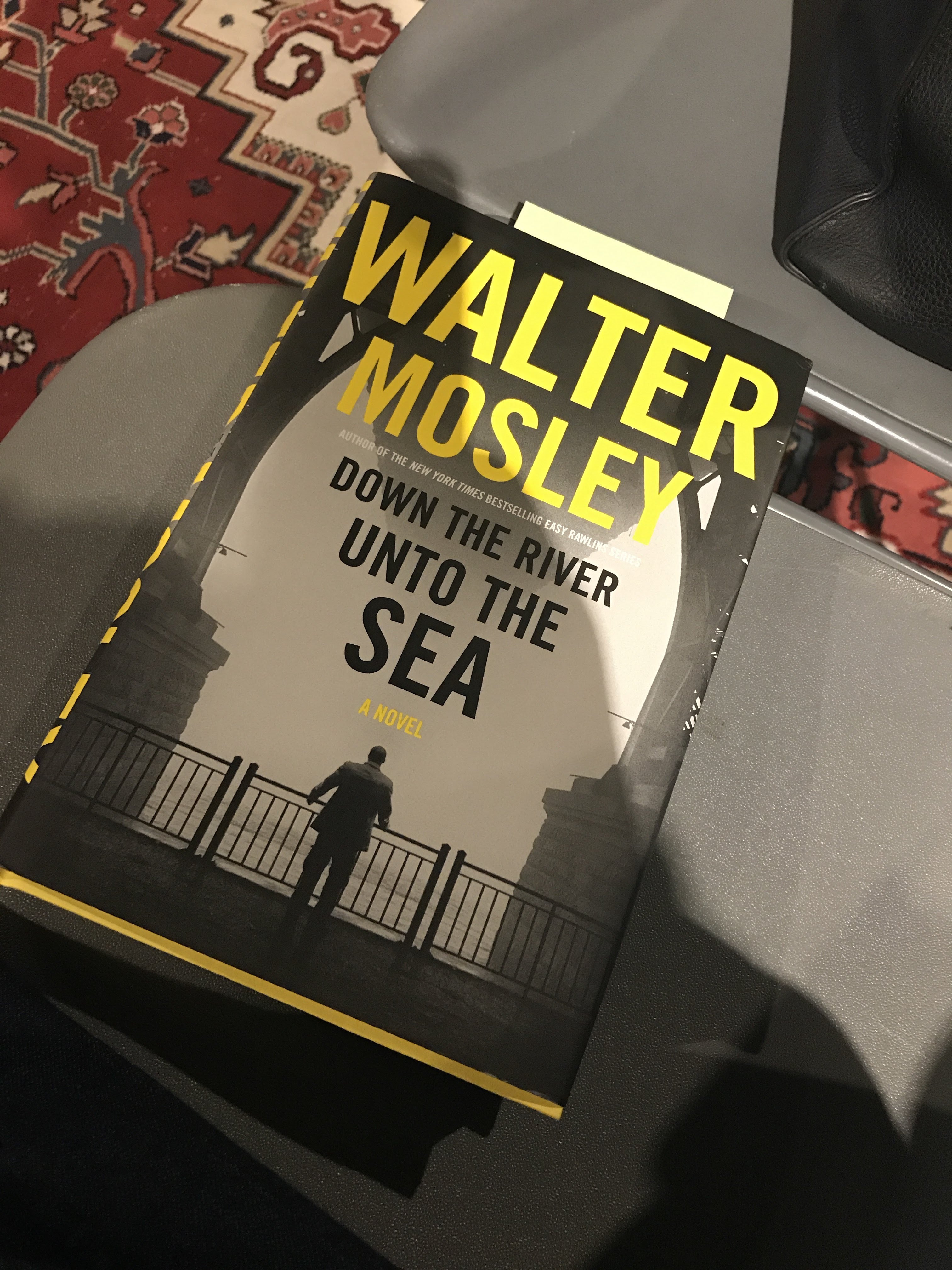
I got my chance! Earlier in March, he came to Murder by the Book to talk about his latest novel, Down the River Unto the Sea.
He was delightful and funny. I also noticed how many black readers were in the room. This is significant because, for the most part, I usually see more affluent, white readers in the room for book readings and signings. This was so refreshing to see.
When I got to Mr. Mosley to sign my book, I could FEEL myself freezing. I pushed through it. Who knows what when I would see him again. Who knows when I would get the opportunity to tell this person that they influenced me at a critical part of my writing life.
But, when I went to say all these things and decided against. Not because I froze again but because sometimes you just need to let your heroes stay heroes.
I wanted to keep him on that pedestal because that was where I aspired to be. One day I do want to have that conversation with Mr. Moseley but I’d rather have it as a colleague. I’d rather have a beer with him and talk shop rather than steal a couple of seconds in a book signing line.
So, I took my signed book and had a lovely dinner with friends. I know I’ll have that beer with Mr. Mosley one day. But for right now, I want him to still teach me how to write by continuing being a fan.










 Icess Fernandez Rojas