I know that I have talked about the process of podcasting and how much work it is. But as I work on this season, and conduct the interview with the writers who will be on the show, I am getting excited for you guys to hear the episodes!
I am also excited because I feel like this is my show. It was always my show, of course, but it’s MY show.
That means I make the decisions. All of them. While it could be overwhelming, it is quite liberating at the same time.
Here’s the reason: my former career as a journalist. I remember that I’d have to defend and argue for story ideas. Great story ideas. Some I had to pre-report before pitching to editors. And even then, I had to justify all the time I had spent on the story even when it was my off time.
I’ve also been on other podcasts as well including as a co-host of Tintero Project’s Inkwell and F**king Shakespeare.
But doing my own podcast, I don’t have to pitch anybody anything. There’s no editor. There’s no gatekeeper. It is my voice, my question, my editing, my research that goes direct to the listener.
I have to write it again. There’s no gatekeeper.
So, yes, the podcast is mine. Just like this site. Just like the creative classes I teach. Having this freedom, when there was a point in my life when I didn’t have it, has been the most pleasurable thing I’ve done in my post reporter life. It’s also the toughest gig.
But I love every second.
I also can’t wait for you guys to hear the second season of Dear Reader. Some of the words we talk about include empathy, manifest, grief, resilient, among others.
What a year 2019 has been! I have so many things to be thankful for and so many things that happened that I’m so proud of!
The first thing is that I learned so much about my health, my finances, my friendships and my family relationships and I’ve strengthen them all. That was quite an accomplishment considering that the year contained lots of obstacles.
For me, 2019 was a great year. I couldn’t have asked for better. One of the things that made it a better year was my guiding word: foundation.
I picked that word because I was at the beginning of things but I wasn’t starting over. I knew that in my life there were some holes in my education and I needed some basics. And thus the word foundation came to mind.
That word not only guiding me through figuring out what practices and processes I needed to learn and put in place for my future but also brought some things to the basic level. For example, what do I want to accomplish in the next 10 years? What does being a storyteller look like for me? How does my mental health impact of my creative and professional progress? What is keeping me from the greatness that I seek?
Picking a word for a series of words isn’t an easy process. My friend George “Urban Jibaro” Torres turned me on to this practice. The first year, 2017, I picked trust, enjoy, and cultivate. It was an amazing year. I have since streamlined it to one word. I talked about this process on a special episode of the Dear Reader Podcast.
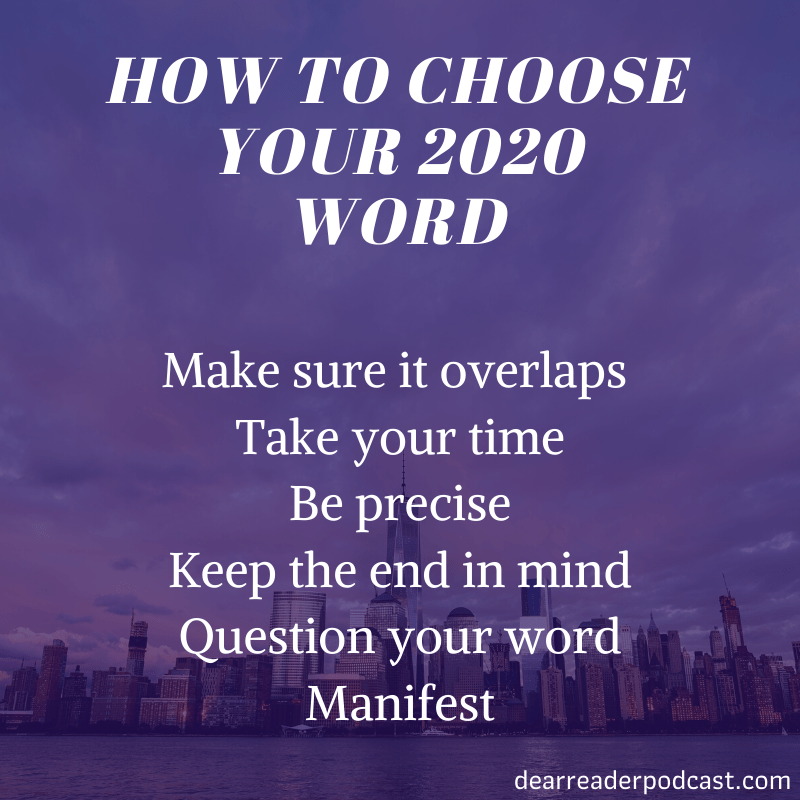
Here’s the tips to choosing your word for 2020.
Choose a word that will overlap to different parts of your life
You may be thinking about one thing in your life that needs fixing. Maybe it’s something dealing with health or finances or relationships. Whatever it is, there is a pattern there and your word(s) need to be able to capture that pattern. And there is ONE WORD that encapsulates it all.
This is going to probably require some research. I suggest writing down a bunch of words and using the thesaurus and/or Google to add to the list. You want to be able to choose from a list based on your own vision for your life.
That also means…
Take your time. Be reflective.
Getting to your word is not going to take an afternoon. It will take a bit. That’s because you will need to be more reflective than usual. This process should take a couple of days to a couple of weeks. Why? Well, it is one word(s) for an entire 365 days.
Also, you’ll need to consider who you want to be at the end of the year. For example, if you use the word kindness, what does kindness look like in your life at the end of the year? Does kindness look like being generous? Does it look like turning the other cheek? Does it look like having empathy? Are you sure what you want is kindness and not empathy?
Also consider what is going on in your life. What is missing? What do you want more of (other than money. We can all use that)? What do you want to leave behind? What would it truthfully take to be or do or create the thing you need in your life? Will it take courage? Will it take focus? Will it take dedication?
Be precise with word
Confident vs courageous
Dedication vs Focus
Healthy vs Fit
See how each of these words are shades of the same sentiment? What do you actually mean? This part, above all of these tips, is probably the most important. If you want to be confident, does that mean you have no confidence now? Is it that you only want to be more confident in certain part of your life. OR do you mean you want to be courageous?
For this, I like to go to the Merriam Webster dictionary and find out what the word(s) mean. I’m also going into the thesaurus to find like words to understand if that is the correct word or if there is yet another word that is similar.
Then, here’s the fun part, I define the word(s) for myself. What does that word(s) mean in the context of my life and what I want to accomplish? If I were to pick courageous, what does that mean financially or romantically? What does that word look like in my professional life? Maybe it looks like applying for the job or the promotion you didn’t think you could get or maybe it looks like finding additional training opportunities or networking opportunities. Maybe it looks like starting a new business. See how that one word can open up some directions for you?
Bonus tip: Make sure the word is a verb
Keep the end in mind
Ask yourself: What does it look like at the end of the year when I have accomplished this word(s)? In December 2020, when you’re looking back at the year, how would the word have guided you toward this vision?
If you’re anything like me, I always need to know how I’ll keep myself accountable or how will I measure this to ensure success? The lovely thing about this process is that you can make that decision. For example, using the example we used above with courageous in the area of the professional life sending out resumes is one way to measure if you are being courageous. Or maybe having said resume critiques and retooled is a step toward the courage to take the next step. Don’t discount the seemingly small steps toward your guiding word. Indeed, you can’t make a leap before taking baby steps first.
Question (aka “interview” your word)
Is that really the word you want? Sit with it. Question yourself about it, asking yourself why this word and why NOW? It’s okay to go back and forth for a while. Again, this isn’t a word you can get to in one afternoon so it’s okay to change your mind or retool the word.
Manifest
Here’s the fun part! This is the part that I love and that I did last year. I’m incorporating this into my word process this year.
Create a vision board.
Yes, do it. This is a way of manifesting.
Listen, a vision board is a visual reminder of what you’re hoping to accomplish for the year. Having that up in a place where you see it often will help keep you on track and will give you a gentle push when you need it.
I personally love the old-school, cutting images from magazines and then pasting them on a poster board thing. Here’s mine from this year.
However, I’ve seen them digitally on cellphones, desktop wall papers, and even Pinterest. How you want to manifest is completely up to you. It’s your word now, you get to interpret it and work toward it however you’d like.
And that’s it! This is how I pick my word. In fact, I’m in the process of choosing my word and will probably share it after the first of the year.
Meanwhile…
To help you remember these tips as you go through your process, here’s a visual!
Let me know what your word is! I’d love to know it and how you hope it will work for you.
Reflecting and shining,
-Icess
Processing…
Success! You're on the list.
Whoops! There was an error and we couldn't process your subscription. Please reload the page and try again.
This week on the podcast, I interviewed Angelique Imani Rodriguez on the topic of risk.
Yes, that four letter word that some of us avoid or thrive on, depending what the situtation.
I’ve lived a risky life, I can say. I left my home to start my journalism career in a whole other city where I know no one. Not one living soul. Then two and a half year later, I did it again, this time a whole other state. And nearly three years after that I did that same thing.
I followed job after job not finding fulfillment.
I have risked not only happiness but also starting this blog long ago was a risk. Who knew what this blog was going to become. I started this site as Writing To Insanity in 2008. Now, in its current form, Dear Reader, it continues to be about writing, the writing life, and now mental health.
Speaking of mental health, there have been risks there for me as well. One day in July 2015, I almost took my life. I took a risk and came home. And that has been the best risk of all, a bet on my self and my mental health to come home and work on the person who is writing this blog post now. I can tell you, dear Reader, she’s pretty awesome!
Risk happens in big and small decisions. Big and small risks. The size doesn’t matter but the sentiment behind it is what is life defining.
Here’s some definition to clarify what risk actually means. There are two entries.
Risk (noun): possibility of loss or injury
Risk (verb): to expose to hazard or danger
Risk, essentially, means you have something to lose. The bigger the thing you have to lose, the bigger the risk. And more often than not, what you are exposing to hazard or danger is yourself.
Angelique Imani Rodriguez is taking a risk. She’s entering the editor arena, daring to put out a collection that may or may not be wanted by the general market. Her name and reputation as a writer is on the line.
It’s a hell of a risk when you’re starting to be known in literature circles but if there is anyone who is up to the task it’s Angelique.
I meet her at VONA in 2015, about a month before my suicide attempt. I remember thinking I wanted to be her friend. There was something about her. She was strong, didn’t take any grief, and there was a light there. I was envious of that light. I wanted a light of my own.
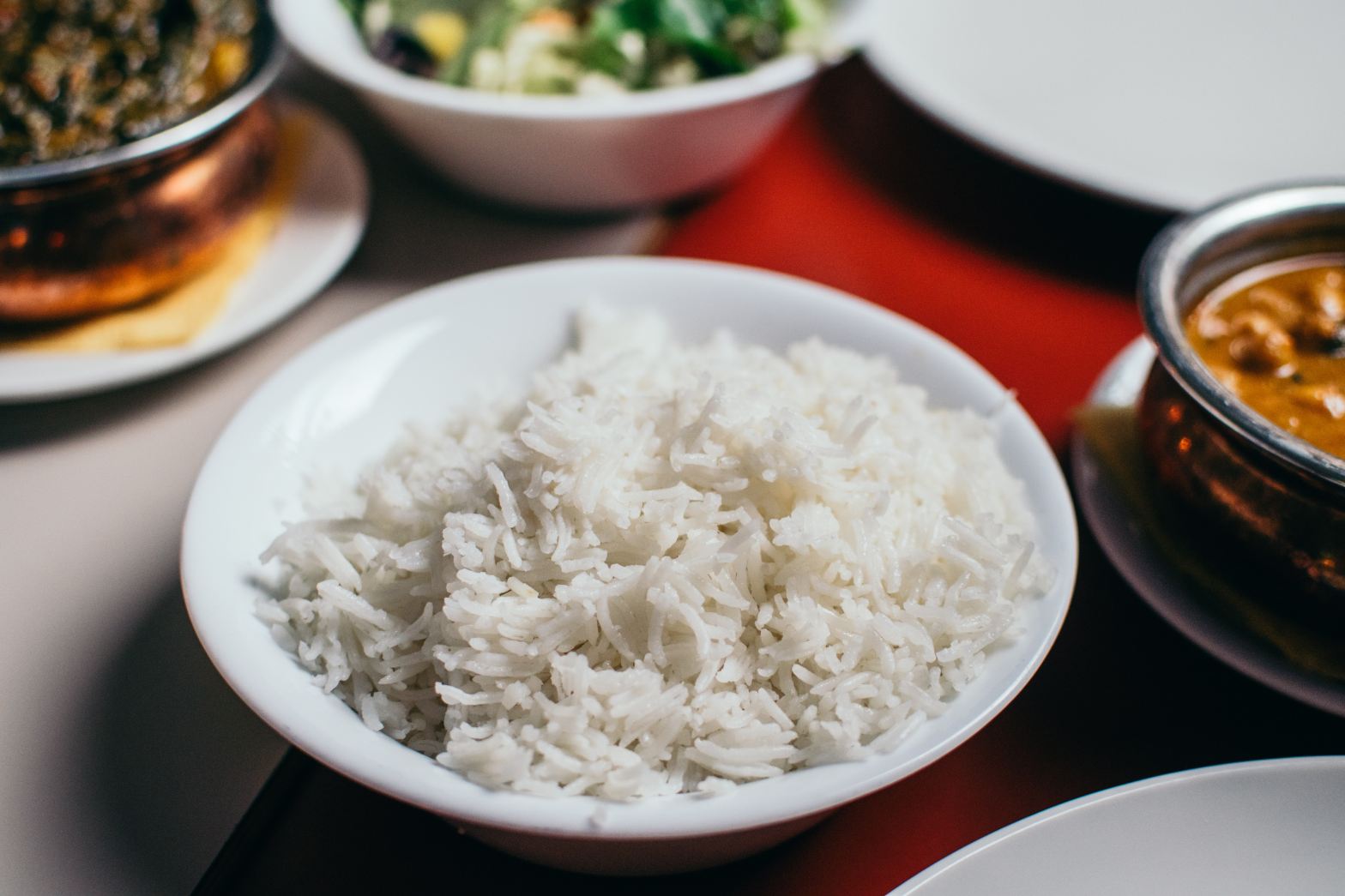
Years later, my friend Angelique has that light in abundance. She was on the edge of greatness then but she’s diving into that greatness now, taking the risk to do something big. She’s editing a collection of work called Fried Eggs and Rice, about how food is tied to culture. The writers are predominately writers of color.
She’s taking a risk here because she’s going against the literary narrative of stories of color. While we struggle and overcome, that will always be our stories, we are far from being victims.
It’s a difficult tightrope to tell the stories of struggle and keep it out of the neighborhood of victimhood. It’s not about exploiting victimhood, it’s about coming out of it, even if it’s with a plate of fried eggs and rice. (Which is DELICIOUS by the way.)
She’s stepping out on faith and taking a chance on herself.
After all this time, she’s still a light. She’s stepping into her greatness. And I am so lucky to call her friend.
This week’s podcast we explored the word “retrograde”.
The inspiration came from the skies and a long-standing fear of a season of time. For those who believe that the way the stars and the heavens move impacts what happens on Earth, we are in Mercury Retrograde.
For those who know of it, it is a couple of weeks of chaos nearly every quarter or so. It impacts communication and travel and machinery. Things shouldn’t begin during this period and people are warned to not sign contracts. I know that for me, at the beginning of every year, all Mercury retrograde periods and blocked off in my calendar. I do not begin new creative pieces during this time and use it just for revisions, which is perfect since I’m in revisions for my current project.
Yes, Mercury retrograde for some of us is real. We treat it with the same caution as a hot plate. However, that’s not the retrograde I’m talking about.
The word retrograde means moving backward. Reverting to something from your past. Relearning a lesson that perhaps you thought you already learned.
I asked my social media friends about this word. This seemed to trigger some thoughts.
For one friend, she said her retrograde is as if she’s “picking up pieces that she never got or that she let slip away.”
Another social media friend said that during her period of retrograde she felt as if “she was dropped down a hole”.
It seems inevitable, that as humans we sometimes fall back into habits or thoughts or practices that no longer serve us. We are creatures of habit after all. It takes the better part of a month to break a habit, in theory, but if you don’t get to the root of why the habit was established, then it’s only a matter of time before the old habit returns.
So do we ever say goodbye to our old habits, old thoughts, old ways? Does that mean that we are not capable of change or that change is fleeting?
This week, I caught myself retrograding. You may have heard me call this year the foundation year, the year where I create and learn practices to set the foundation for years to come. To make it easier, let’s quote Zora Neale Hurston here, “There are years that ask questions and years that answer.” For me, this is an answer year.
“There are years that ask questions and years that answer.” Zora Neal Hurston
However, this week I caught myself doing something I hadn’t really done all year and acting ridiculous as if I didn’t know better. I did. I did know better and thus I felt like I hadn’t learned anything in the past couple of years. You’re probably curious as to what it was. I can assure you it wasn’t life-altering in the grander scheme of things but it was something that didn’t make feel great. It made me feel like I was back at square one.
I have more to learn. So much more. That was the lesson of that retrograde.
Sometimes, moving backward feels like standing still. While everyone is moving on with their lives of delight and fun, you are, indeed, not. There is little delight. There is definitely not fun. It sometimes feels as if you’re being punished as if you didn’t do your homework on time and so you’re stuck inside doing math problems while everyone else is on the jungle gym.
If that doesn’t sound like a recipe for anxiety, I don’t know what is. Just the image of that is making me anxious. But the idea of moving backward or standing still can be anxiety-inducing, most especially when one compares themselves to others.
Have you ever compared your life to a friend’s life? Maybe they have reached a level of success in their life while you’re still trying to do the very basic things. They may have become engaged, purchased a new home, got a big promotion at work. Maybe they are able to move in circles differently than you, more at ease.
And it’s not that you’re jealous. The emotion is more internalized. You are wondering what is wrong with you? How come they figured it out and you are on the sidelines. Add to that the fact that life is now lived on social media where we document the best part of our lives and, yes, moving backward can make it seem like the walls are closing in.
This reminds me of one of my favorite under-rated shows. Being Erica was a Canadian television series that focused on a woman in her early 30s who doesn’t quite have her life together. She’s working a dead-end job while her friends and sister are living amazing lives — great jobs, great relationships, new adventures — while she peeked in college. For a while, I was Erica and the world was passing me by.
In an article in British Glamour, 29 percent of women between the ages of 18 to 24 years old suffer from anxiety. States-side, 40 million Americans have an anxiety disorder of some kind like generalized anxiety disorder, OCD, or PTSD. What may be triggering this? Worry and stress are for sure the big ones, especially if you’re worried about how you’re not like everyone else, or how you’re not where you’re supposed to be. This is usually dictated by social or cultural norms.
This is the fear of missing out, or fomo, as the kids say.
I have felt this may times in my life, more times than I care to admit. The anxiety from this is real. Whether it is fuel or fodder to make life big changes or whether it is crippling, the anxiety is the same just used differently.
But let me offer some relief to all this. A switch of the lens. Maybe we’re looking at this all wrong. Perhaps we need to think about how retrograde could be a good thing, how backsliding or fear of missing out is something we need to feel once in a while.
Remember how earlier I mentioned about my retrograde, my slip into a habit I wanted to obliterate? I felt bad but I also knew why. And yes, I was disappointed in myself but I knew that it was a stumble, not a complete fall. I know that I’ll have to get back into the habit and identify what triggered my regression. It’s steps. It’s small questions to chip away at the big answers. It’s going backward, not starting over.
Soren Kierkegaard said that “life can only be understood backwards; but it must be lived forwards” Life then requires reflection, even when you mess up and return to something you’ve long abandoned.
“life can only be understood backwards; but it must be lived forwards”
Soren Kierkegaard
And reflection is how one learns. Guys, retrograde is about learning or relearning what you truly know. Retrograde is a test, a mid-term, a multiple-choice test and you are given points not if you don’t repeat the same mistake but if you learned from the repetition and came out on the other side different.
In narrative writing that is called the Hero’s journey when the hero goes through tests and tribulations and comes out the other side of things changed. Forever different. Growth has happened. The sky is just a different shade of blue, not brighter or dark but just different.
What retrograde is trying to teach us to be our own heroes and sheros. Let’s try to do that the best we can.
A five-letter word that is so loaded, more for some of us than others. For some of us, pausing is similar to stopping and that in itself is overwhelming. But one thing doesn’t mean the other. Of course, stopping means ending something for whatever reasons.
Pausing, however, isn’t a defeat but a respite. It’s acknowledging that breathe, and thought, and being intentional is just about as important as doing the thing you’re doing.
That makes pausing necessary. Oh so necessary.
Today’s guest, Hugo Esteban Rodriguez, knows about pausing. This is a practice he uses every day not only as a writer but as a human with Attention Deficit Hyperactivity Disorder or ADHD.
“Being about to pause and process has helped me a lot in my life” Writer and educator Hugo Esteban Rodriguez
In our interview, he discussed how pausing helps with the little things like putting his keys in the right place or making sure that a pen doesn’t stain his clothes in the wash. These are just simple things but pausing helps him gain control in a world and with a brain that can be filled with chaos.
And what of the writing? Hugo uses the Pomodoro Technique. You may have heard of it. It’s setting the clock for a 25 minute focused session on one task. After that session is over, you receive a 5-minute break or pause and then another session begins, hopefully, to complete a task.
This is a technique I use but I feel I need to do this more often. Pause, Hugo said, allows him to focus and thus he becomes a better writer, a better teacher, a better human.
Now, this is the part when I talk about the idea for this episode, the origin story. I missed two work deadlines. These deadlines were on my schedule for weeks and I had been working toward them in all that time. But, I missed them. One of them by only a couple of hours.
For me, this is a point of shame. I pride myself in the caliber of work that I do and being able to juggle many things at a time. It’s the old reporter in me. Deadlines are what fueled my career for so long. So missing one was devastating.
However, missing deadlines that I knew about was even worse. I was overwhelmed with too many things happening at the same time, too many other deadlines needing my attention, too many things on my plate.
And that feeling of shame and overwhelm broke me down. That’s when I needed to pause. I needed a break from these emotions and to just talk myself down from the negative thoughts that were starting to build. Anyone with depression knows that these thoughts are like storm clouds on the horizon, you know exactly what comes with them.
In my pause, which happened to be a full day, I forgave myself for missing deadlines. I regrouped and reorganized. I watched a movie. I spent time with family. I did a little writing. It felt amazing getting back to basics, if only for a little while. The next day, I could tell the difference. By pausing, I had a better class the next day, I whipped through a stack of grading, and I kept going with more confidence.
Knowing when to pause has been an ongoing journey. Just like one should know the triggers of their mental illness, one should know when to take a beat for themselves. But that knowledge only comes when you’re paying attention or being mindful.
Pausing is a thing. Earlier in this podcast, I challenged you to pause, not to do anything for the duration of this episode. The episode is over, how do you feel? Ready to get back to it? I hope you are and I hope you got something from this episode that will help you with the rest of the week.
A special thanks to our guest writer and educator Hugo Esteban Rodriguez. You can find him online at his Instagam at NoPalySabal. His book “And Other Stories” is out now.
A whirlwind week! That is how I would describe this past week. Between grading, teaching, coaching, writing, and podcasting, I’ve been running in a large circle.
In case you missed it, I started my podcast as part of National Podcast Post Month. It’s similar to National Novel Writing Month except it’s with, you know, podcasts.
Going into the month, I knew I wouldn’t be posting everyday. That wasn’t going to happen. My schedule doesn’t work that way, as you well know.
So I decided to post twice a week for the month and then see what to do for the rest of the year.
That little lesson is one of many that I’ve learned so far. Yes, even this late in my creative game there are so many lessons and I find that exhilarating.
So, in the spirit of sharing, here are some lessons learned.
Don’t wait for perfection, just start
This is a re-learned lesson. I had started planning this podcast in the summer. I thought it’d be out just as the summer ended. However, I was in the middle of a manuscript and I knew better than to start a project before I was done with another. And yet that’s what I did.
Just an aside, I’m still working on the manuscript but it’s nearer to completion.
It wasn’t until last week that I uploaded the first episode. I wasn’t ready to go. There are still people I wanted to pitch to that I hadn’t done yet but here’s where I am with things like this…
I can plan everything or I can just do it and fix along the way.
So I decided that was the best for me and it was the complete right decision.
I REALLY LIKE doing it all myself
Okay, so I guess I’m a control freak. Sue me.
I like thinking of the concept, writing the script, recording, editing, uploading, and distributing the podcast. I mean I LOVE IT! It’s a lot of work but I enjoy it.
There’s something about not having anyone or any gatekeepers and being responsible for your own work that makes me happy.
After 12 years of being a reporter and being told what to do, it’s nice to be able to do my own thing and rely of my storytelling and interviewing skills.
I am so really lucky as I have an amazing friend who I can go to for technical questions. I know that I’ll be taught how to fix an issue. That way, I’ll have that knowledge forever.
Okay, let’s get this straight. I know how to do a lot of things. Like a lot. It’s a weird thing.
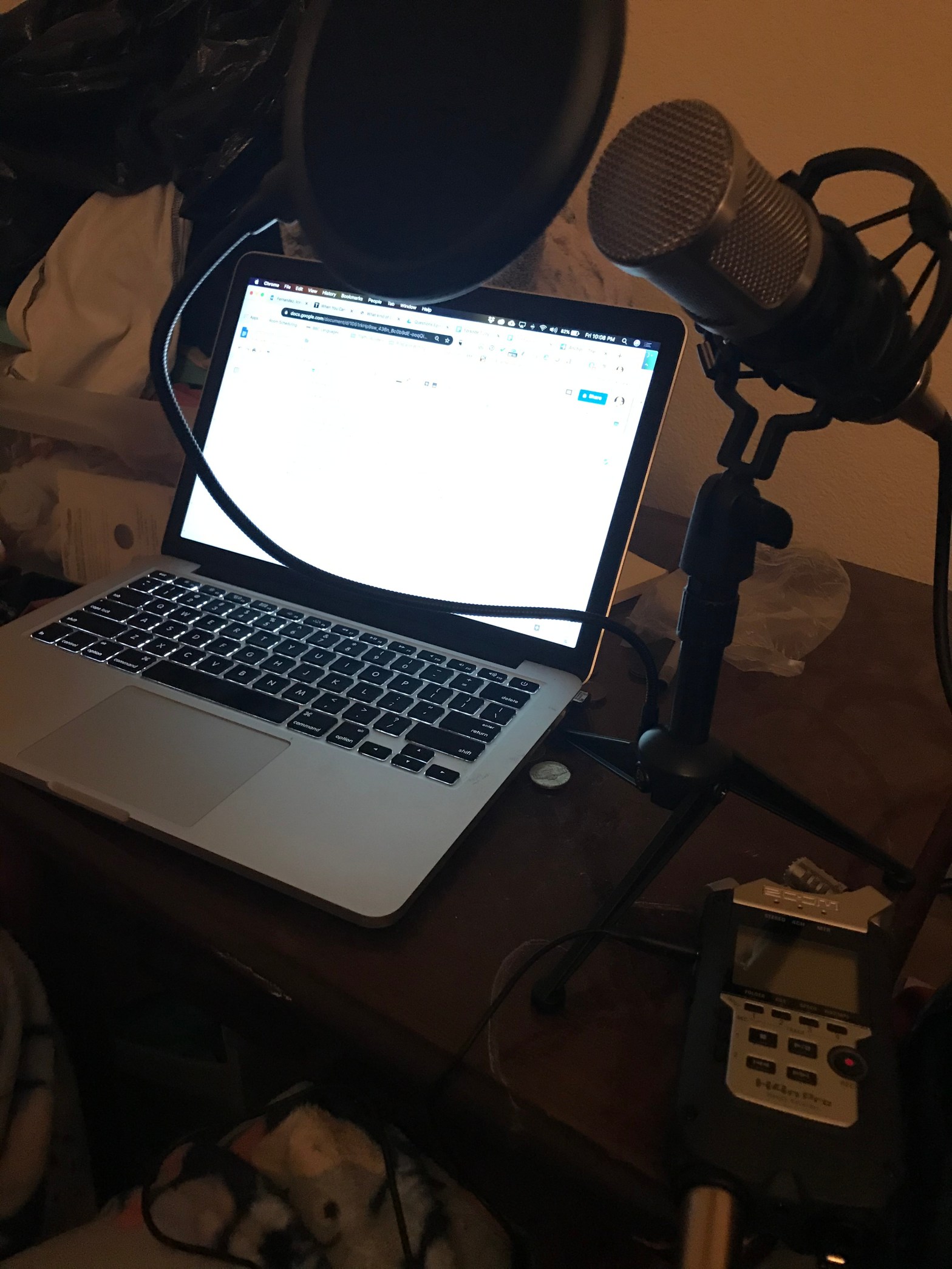
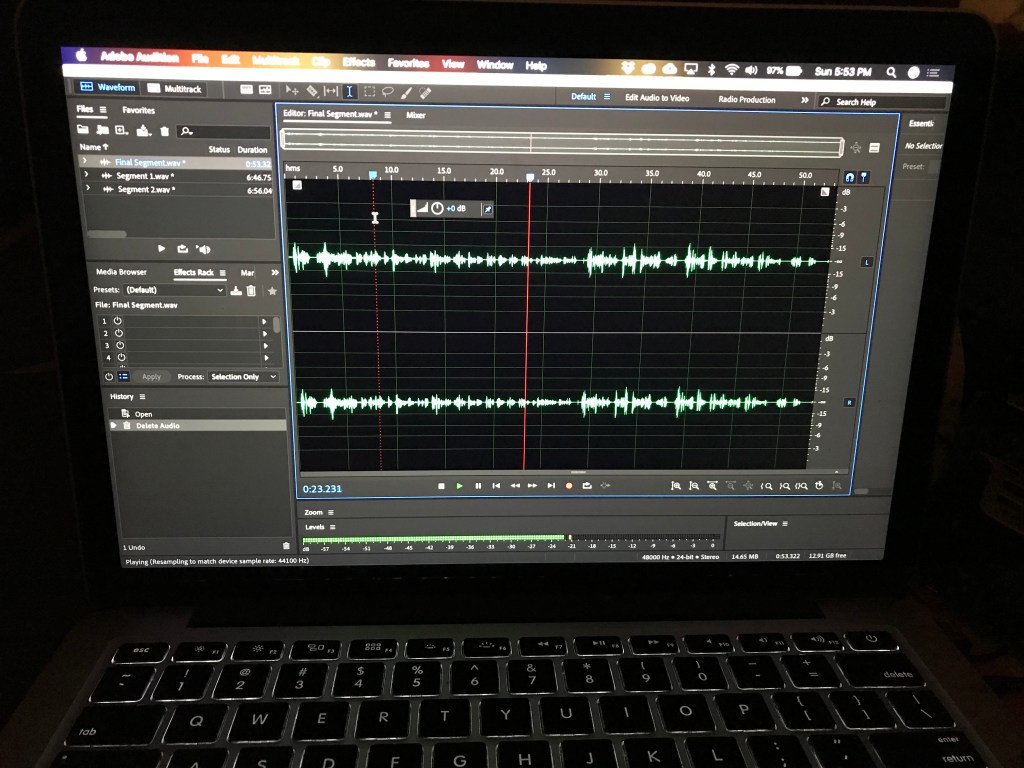
Here I am editing an episode of Dear Reader:The Podcast on my laptop. I use Adobe Audition for some of the heavy lifting.
And with podcasting, I’ve had to use so many of them. So far I’ve used:
Writing
Voice performance
Audio editing
Presentation skills
Social media
Marketing (I need to learn more about this)
Interviewing
Storytelling
Research
Pitching
Every inch of critical thinking
And these are just the ones I’m remembering for this blog post. I’m sure there are more that I’m missing. Yes, a lot of skills to put together an episode.
Tell stories. Always.
Bottom line, creating an episode of a podcast is about storytelling and I am a storyteller. I aim to be a master storyteller.
I want to tell stories across several mediums. From the written word to the spoken word to visual, I have something to say and I want to say it all.
I want to tell stories across several mediums. From the written word to the spoken word to visual, I have something to say and I want to say it all.
I’m so excited about today’s episode on the Dear Reader Podcast!
My friend Dr. Trevor Boffone is a jack of all trades. He’s currently a Spanish teacher at one of the local high schools in Houston but you may know him from this:
Or maybe you know him from this:
Yup. That’s my friend Trevor with the sick dance moves!
He’s a guest on my show today talking about the guiding word: opportunity. He’ll talk about what it is, what it looked like for him and how to recognize it even dealing with tragedy .
Also on the show I talk about the latest in my writing life and the book at is shaking me to the core right now, “I’m Telling the Truth but I’m Lying” by Bassey Ikpi.
The podcast is available is lots of places now — Google Podcasts, Breaker, Radio Public, and, of course, Spotify.
Yes, this is a thing I’m doing now IN ADDITION to everything else.
No worries, Dear Reader, I am still writing on this site. In fact, I am going to predict now that the podcast will being be back to this site because the podcast name is…
Dear Reader: Mental Health and the Writing Life
Yes! The podcast is an extension of this blog and feel like it’s almost a return to me in a way. Man, I miss writing for you guys but, you know, life happens in the way that it happens and priorities are what they are.
I do have to explain, however, that this podcast was months in the “making” and by “making” I mean I was planning it and getting guests lined up before I had to focus on other things. But November, in addition to being National Novel Writing Month, is almost National Podcast Posting Month. I decided to take a plunge just to see what happens. So, we’ll see what happens.
As an aside, the idea of National Podcast Posting Month is to post everything. That’s not going to happen. But I’ll be posting most days as an exercise and to get into the podcasting habit.
So far, the podcast has made it to Spotify, Google Podcasts, and Breaker.
My Podcast’s lead image. It’s okay for now. I’m for sure changing it when I decide what I really. But meantime, how’s this for show?
Check out the first episode below. Yes, I’m on Spotify. I’ve decided not to think about that until Christmas, when I have more time.
So what’s the premise of the show? Every episode we talk about some aspect of mental health and/or some aspect of writing. I’ll of course have special guests on the show from time to time. During this November, the show will hopefully get its voice but once it actually has a full planned season, it will be more structured. In fact, to get an idea of what that kind of show episode can sound like, listen to episode 3 on Tuesday!
As you guys read this on Monday morning, a new episode would have done up! Episode 2 on Spotify or on my hosting site, Anchor, where you can leave me messages if you’d like.
Soon, I’ll add a link to the menu here on the site where you can access all the episodes. Give me a second, however, I’m flexing muscles I haven’t flexed in quite awhile.










 Icess Fernandez Rojas