Resolutions and writing don’t mix

Writing resolutions are eh. 

Hello everyone!

It’s great to be back! I took an amazing month and a half break from writing and except for the story I wrote for the Holiday Blog Tour, I stuck to it.

I’m so glad to have taken the break but even happier to be back.

Since this is the first post of the year, this is usually when I write about resolutions. Though I’ve written about resolutions in the past, I’m not sure that writing and resolutions are the way to go.

Don’t get me wrong, I do believe that there should be some goals in writing but they should be goals, not resolutions. That means that there has to be a plan attached to achieving those goals and those goals should be as specific as possible.

Yes, I said specific.

If your goal is to publish something this year, that’s not specific enough. What do you want to publish? A story, a poem, a book? Where do you want to publish? In a journal, self-publish, small press, traditional?

Next ask yourself, what are the steps you need to take to get there? Need more time? Then think about getting up earlier or sleeping later. Think about writing during your lunch hour. Look for pockets of time 10, 15, 20 minutes and brainstorm how to use them. Could you outline something, brainstorm on an idea, sketch out a scene, revise a paragraph or a chapter during those brief amounts of time?

If your goal is to publish a book, what do you need to do to get there? Do you need to consider publishers, agents? Get a query letter or cover letter ready. Self-publishing? Research options. Find an editor or two or three.

I’ve always been a fan of the smaller goals leading into the bigger goal. I like to take it quarter by quarter. So where do you want to be by the end of March in your 2013 goals? It’d be feasible, depending on you time, to have a couple of chapters to half the book revised. Or it would also be feasible to have a couple of short stories out for publication while polishing the next batch of stories.

So, what are your goals for 2013?

How I finished NaNoWriMo


Mobile viewers can see the video by clicking here.

I won NaNoWriMo.

In life, you need to celebrate the wins and I needed to celebrate this win.

If you’re a long time reader of this blog, you’ve probably know that I’ve tried for several year to finish NaNoWriMo but never did. This year, I totally kicked it in the gut and stole its lunch money. I’m  totally excited!

In the name of celebration, I did another vlog showing my excitement. I was inspired by vlogger, Poppy at Poppy Writes A Book. You can follower her on Twitter here. Her vlogs are so great and personal, I decided to do one that’s personal as well, though they are not as good as hers.

Winner, winner chicken dinner! 

So, if I had to figure how I finished NaNo this year, other than sitting down and writing when I didn’t want to, I’d have to give a lot of the credit to Scrivener, a fantastic piece of writing software. 

No, I’m not getting paid to write this post for Scrivener. How is this software different from Word or other word processors? The ability to have different documents for different scenes is amazing. What’s more amazing, the ability to move around the scenes by dragging them. You can organize those scenes into chapters, upload your background info, and, if you’re into plotting, create index cards that are tied to you scenes.

I used this feature and didn’t write in order. I jumped in the time line to a scene I knew would happen and I wrote all those scenes first. Then I wrote the scenes that lead up to those scenes. And then I wrote the aftermath of those scenes. By jumping back and forth, I was able to keep up momentum and for the most part, I knew exactly what I would be writing on any given day.

Another feature that I LOVED and helped me to finish was the compile feature which allows you to put all your scenes together, insert chapter or page breaks, and save it as a Word, PDF, or text file. It also creates a title page for your project.

But above all that, the feature that helped me the most is the full screen feature. That means I hit a button and the screen would fill with my words. No internet, no start button, no nothing–nothing else is visible, only my text. When it came to word sprints, this was extremely helpful.

So, if you’re wanting to use it there’s a 30 uses free trial. (That’s uses, not days.) I used the heck out of that trial and then paid my $40 for it. It’s worth the money, I promise.

Did you finish NaNoWriMo? What helped you?

Inspiration and delirium

Note: This post is sponsored by Kleenex Share Pack, Care Pack, and Latina Bloggers Connect 

Inspiration comes in many forms. It comes on a walk, or from song. The shower has been a constant source of inspiration for many creatives.

For me, one of the places I get my inspiration from is Houston, more specifically my childhood home. This has been my epicenter of inspiration .

Ironically, one of the biggest lessons I’ve learned as a writer came when I was home during this time last year.  Inspiration hit while on my sick bed. How sick was I? I’m talking I can’t drive back to Louisiana sick.

Mom called my boss to let them know I wasn’t coming to work. Yes, THAT sick. It was like being back in school all over again.

Since the good folks at Kleenex (for the Spanish version click here) are paying me to write a post, I’d thought I’d write the tale of my last sick time in Houston. This is as a fable –there’s a story and a lesson at the end. Stick with it.

Like I said, it was this time last year. I was home exactly 2.5 seconds when the first cough hit.

“Oh, it sounds like you’re going to be sick.” Mom said with a knowing smile.

“You don’t know me,” I said jokingly.

Oh buts he did. And she knew my cough. By day two, I was in bed sneezing, coughing and generally waiting for death. It hurt to breathe and all I wanted to do was sleep. And I did.

Thanks to the folks at Kleenex for sponsoring this post. 

Those dreams were ripe for storytelling but to this day, I can’t remember what I dreamed. However, I knew my over active imagination was to blame for me waking up in the middle of the night as much as my cough. I worked through plots of novels I had yet to write. I worked through plots of novels other people had written. I was fairly certain that during one of these episodes of delirium I may walked around the house thinking I was back in high school and got ready for school.

My mom, of course, stepped into the role of nursing me back to health easily. It was like I never left. Theraflu, honey, Vicks rubs, alcohol rubs and, I’m fairly certain, rum was probably involved at one point. Chicken soup, caldo, orange juice — there was enough liquids in me to burst.

Eventually, after about a week, I got better. I was able to get out of bed, eat solid foods, and actually have a conversation without sneezing. I was even allowed to go to the living room and watch novelas with my mom. (Spanish soap operas are kind of our thing.)

That’s when I got to thinking about the care my mom took in making me well again. She was patient, kind, and lost some sleep herself in all this.

Writers are like moms. Our characters are our children. Isabel Allende said that fiction comes from the womb. That means we give birth to our stories and creating them on the page is a hard birth. In the center of all that are the characters. They are the center of the stories, their experiences and thoughts are at the epicenter.

We know them well and when they start “coughing”, we already know what will happen. As writers we just have to be ready to nurse them back to health.

It’s ironic that years after I moved out of my childhood home, I’m still learning from my mother. She never ceases to amaze, and teach.

NaNoWriMo is over. Now what? Revision time!

Revision is GOOD! I promise. 

Hey fellow writers and NaNo novelists!

For those who participated in this year’s National Novel Writing Month, let’s all breathe a collected sigh of relief. We did it!

Siiiiiiiigh.

Whether you won or lost this year, you have a lot of which to be proud! Starting is the biggest obstacle. By starting your novel in November, you are already ahead of the people who just talk about writing.

So, what’s next? You are about to enter the wonderful world of revision and its not for the faint of heart! Revision is one of those love/hate things about writing. There will be times you love it and times where you’ll wonder why can’t you write something perfect the first time.

Take heart, every writer revises and no two writers revise the same way. Books are written in revision and though your process for creating the novel went one way, your process for the revision/writing will be different. It should be since this is where the heavy lifting happens.

Here’s how I do the heavy lifting, the revision part of this process. This is something I used during my grad school days that I’ve retweaked. You’re welcomed to use this process or adjust it for your own needs.


Mobile uses should click this link to see the video.

It starts with the memo. Yes, a memo. Right now, while everything is still fresh, write a memo to your self giving your impressions of your novel. Be sure to include what you think you still need to do or what you should remember to do, i.e. add foreshadowing, add figurative language, etc.

After that, walk away. You will want to start diving into the revision. Don’t. Though you wrote a novel in a month, there is no race for revision and you really don’t want it to be. You want to be deliberate and focused. Burn out is not a good thing during this process. While NaNo may have been a spirit, revision is a marathon so take a breather you’ve earned it!

Come January, however, it’s time to get some work done. That’s when you’ll read your NaNo novel for the first time all the way through. Read it like you would any other book and write down your impressions in your memo. Careful though, this is not the time to do the heavy lifting. This is when you begin to access what exactly you need to do. You can do the small things–periods, commas, capital letters, etc–as you’re reading but the bigger items like writing scenes, adding lines, etc should be done later.

By now, the memo would have lots of suggestions from before and now after. This is where you start the revision. The big things on the list, for example writing new scenes or chapters, should be the first things you tackle. You can’t revise something that doesn’t exist.

From there you want to revise from big to small — chapter by chapter, scene by scene, paragraph by paragraph, line by line. Take the time to do this with each chapter. For me, I’ll take about two weeks just on one chapter depending on what is in it and what I want to do it. This is where the heavy lifting happens. This is also where the grammar fixing happens. I’ll probably read the chapter several times, almost committing it memory by the time I move to the next chapter.  I’ll also read it out loud to hear how the words sound.

When I’m done, I’ll want to write another memo giving myself notes and reminders. I’ll step away from the piece for at least two weeks and I’ll repeat the entire process, this time printing out the entire novel and working from my paper copy.

This may seem like an involved and long process but it should be. You want the best version of your novel out there in the masses. After all, it’s your calling card.

What is your process like? For more on revision, click here to see what I’ve written in the past.

Teachable moment: How to ruin Wuthering Heights and fix your story

I sat in a dark theater tonight horrified at what I was seeing. One of the story lines of my favorite novels of all time was ruined. What story?

Wuthering Heights.

Yes, that novel has been around longer than all of us have been alive and has been translated to film a dozen times. How can you ruin that story line? Story structure and lazy characterization. I decided to make this a teachable moment on characterization, investment and pay off, etc. Here’s my take.

WEBINAR: How to create awesome characters

Update: Thanks everyone for joining in! Sorry that the video cut out in the end. I went ahead and did another video so that we have the entire presentation in a video. 

Check out the list of blogposts that will help you with your characters. To see the presentation I used in the video, click here. 

***

Thanks everyone for joining!

We’ll be live soon. Right now, take some time to start submitting questions in the chat box or going through the list of links I have posted.

I’m excited for today’s class!

Mobile users can see this video by clicking here.

Presentation: How to create awesome characters. 

Articles/blogposts

Goal, motivation, conflict video

How to create characters 101

How to create likable characters

You’ve got questions, your characters have answers

When a character comes out of the closet.

The writing process: an exercise in characters

The basic structure of storytelling — goal, motivation, conflict

Preview: How to create awesome characters

I’m extremely excited about tomorrow’s webinar on how to create awesome characters. I’m working on the class now to make sure I cover as much as I can in the hour that we have together.
In case you wanted to know more, here are the details:
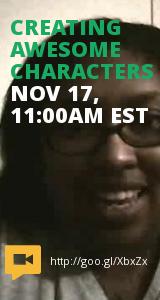
When: Saturday, Nov. 17 (tomorrow) 10 am CST
Where: Right here! If you’re on Google+ you can also catch it on my page. 
Why: Because every single story needs an awesome character.
Here are some of the things I’m planning on touching on:
Building a character from the ground up
Exercises to get to know character
The perfect villain (this one is my favorite)
Collecting characters
Character leading into plotting.
It’s going to be a great time and I hope this helps a lot of you guys with your writing. I also hope you are submitting your great prose to let the world see it. 
Hope to see you tomorrow! 

Four writing lessons learned from doing NaNoWriMo


For mobile users click here to see the video

I started out the day today being behind in my word count. Not by much, however. Just the same,  it was still worrying me. After being ahead by at least two days, it was a bit crazy to be behind by a couple of hundred words. Covering the election completely rearranged my world. Days after the election, the last thing I wanted to do was to write.

As a result, I took some time last night and grinded out some words. As I approached my word count for the day, I noticed something. I was almost done with the first half of the story. I may be done at around 20,000 – 25,000 words but I’m starting to see the light at the end of the first tunnel. I remember this feeling. It took me months to have it while writing my thesis. Now it’s taken me 15 days to feel it. It’s weird that that has happened.

So I wanted to share some lessons so far about writing and the marathon race that is novel writing I’ve learned in 15 days.  The videos will also be helpful, especially the bottom one.

1) The devil is in the details but you can leave the smaller ones for later.
I think my protagonist has two different last names. The place where she works has changed. But I don’t care! I can change all of that in the revision process. Yes, that process that will happen after you’re done writing this thing because it’s so not ready to be seen by the world. So I take solace in that. There will be a revision process so for now just write.

2.) Sometimes you just have to write through it.
Last night I fell asleep writing. Literally in mid sentence I was face down on my keyboard. It would have made a great picture! I was only able to do 500 words but that’s 500 more than what I had before. The day before, I was also tired and I just wrote through it. The lesson here, in case you haven’t learned it, butt in seat fingers on keyboard.

3.) Let the characters tell you what to do.
Yes there’s this big outline that you spent lots of time working on. For me, the outline has since been replaced with the awesomeness that is now on the page. The big bullet points are still there but the journey to get to them is now different. The characters tell me what’s next and how the conversation and the dialogue will go. This just reminded me that we as writers are really not as powerful as we think when it comes to bending characters to our will.

4.) You’be be amazed what you can do in 15 minutes.
I can average 500-600 words now in 15 minutes.  Up from 400 when I started on Nov. 1. When you know you have 15 minutes, you get to working. Wonder how I can apply this to other things? 15 minute chores, anyone?

So I’m behind in my word count but it’s nothing that a good word war couldn’t fix. Where are you in NaNoWriMo land? Let me hear from you!

How to create awesome characters


If there is anything I know well is that characters are awesome.

Haven’t you ever read a book that stays with you? You think about what happened to the character you’ve gotten to know. You get angry at them, you feel for them, you laugh at them.

For the writer, it’s the same thing. We fall in love with our characters — the good ones and the bad ones. We get to know them how you get to know them, page by page.

But creating characters to fall in love with is easier said than done.  Creating these type of characters goes beyond acknowledging they exist, there is a tangible magic to it.

I’m teaching a webinar through Google Hangout on Saturday at 10 CST right here on this site about how to create awesome characters. There will be a chat room open as well so you’ll be able to ask me questions live.  This will be a can’t miss if you’re a writer.  Bring your questions and take some notes. It’s time to make your characters awesome!

Time: 10 am CST
Day: Saturday, Nov. 17
Place: http://www.writingtoinsanity.com

Hope you can make it! If you’re planning on attending, leave a comment on this post!

Should writers blog? Are you Chuck Norris?

Are you Chuck Norris? I think you know the answer to that. 

I can’t believe I’m about to write this. 


Not every writer should blog. 

There. I wrote it. It feels good to get that off my chest. 

As writers, when we do our research on how to sell our books we get this idea. We start Twitter accounts, and Facebook pages, and blogs and we believe that that’s enough to sell a bunch of strangers a book or two and build our author platform.

You’re kidding, right? 

Writers are moody creatures. We like to complain often about how we don’t have time to write. How, if we didn’t have to do whatever, we’d be writing. I agree with that to a certain point. Though it would be nice to wake up with few responsibilities other than crafting fantastic prose, I know that the reality is rent is due every month. My car note doesn’t pay itself. And my cat, though cute as she is, is not a fan of starvation. Neither am I.  

So we have little precious time to write and to share that time with a blog that may or may not eventually help you sell a book–you must be NUTS! 

I’m not. This blog has made me a better writer. 

Knowing that I have to have a post nearly everyday has forced me to keep a list of ideas with me at all times, to take pictures of things I see that are interesting, and to think about how to best help the folks reading this blog. It’s forced me to think about my audience.  While several writing gurus will tell you to not think about them when you write, you still should because a reader is not going to stick with you if you don’t eventually get to the point of what you’re writing. With each post, I know I have to get to the point the best way I think I can. 
This blog has also been a great lesson in discipline and time management. I consider myself a working artist, which means I have to have a day job. My day job is pretty demanding so I can’t spend hours writing a post. I usually put 15-20 minutes on the egg timer and write a post quickly. Don’t think. Write. (This is similar to word sprints.). After that, I’m done. I set the post aside and then come back to it when I have another 15 minutes. I edit, format, post. Does this process sound familiar? 

Learning to manage time and forcing my butt in a chair has spilled over into my writing. I know writing is in the revision so I give myself license to be sloppy and dirty with my first draft before setting it aside. And just like with blogging, I return to my writing to edit. I may not be the best at editing but I think I’m getting better and its due to this blog. 

Sharing my journey as a writer and helping you guys with your writing has become a joy for me. Writers forget that sometimes, how writing can be a joy. So they sit and write and labor and forget to have fun. This blog reminds me to have fun and allows me to be social with my new and old friends. I love getting comments on posts and on social media; I try to respond to all of them. Comments give me instant reaction, which is something writers don’t get until they release their creation into the world. 

But some writers don’t see it this way. They think of the bottomline, which is okay is I guess but that thinking misses the big picture. Blogs help your writing. Writers who don’t see that should steer clear.

I’m sure Chuck Norris would agree with me.