Starting the right way, right away

Starting the right way

I am convinced that the meaning of life is knowing how and when to start over.

In my life I’ve had starts and restarts. As a journalist, you have to. It’s a couple of years in one stop and then several years in another stop and then you go again and again.

In fact, a year ago I restarted, excited for the adventure in front of me.

But this time, I decided to restart a bit differently. This time I decided to be daring and bold.

Continue reading “Starting the right way, right away”

Dear Reader: Finding art in routine. A pre-VONA post

Dear Reader (1) Dear Reader,

It’s a muggy day in the DFW.  I am listening to Coltran on my iPad and wondering where I have left my cell phone.

It’s not that my night was so wild that my phone is out somewhere. It’s that I’ve misplaced it in my apartment as my trip to VONA looms.

I leave tomorrow for a week that is sure to be life changing in some way and losing my phone is just an example of how unprepared I am for the week ahead.

Continue reading “Dear Reader: Finding art in routine. A pre-VONA post”

3 writing tips from published mystery writers

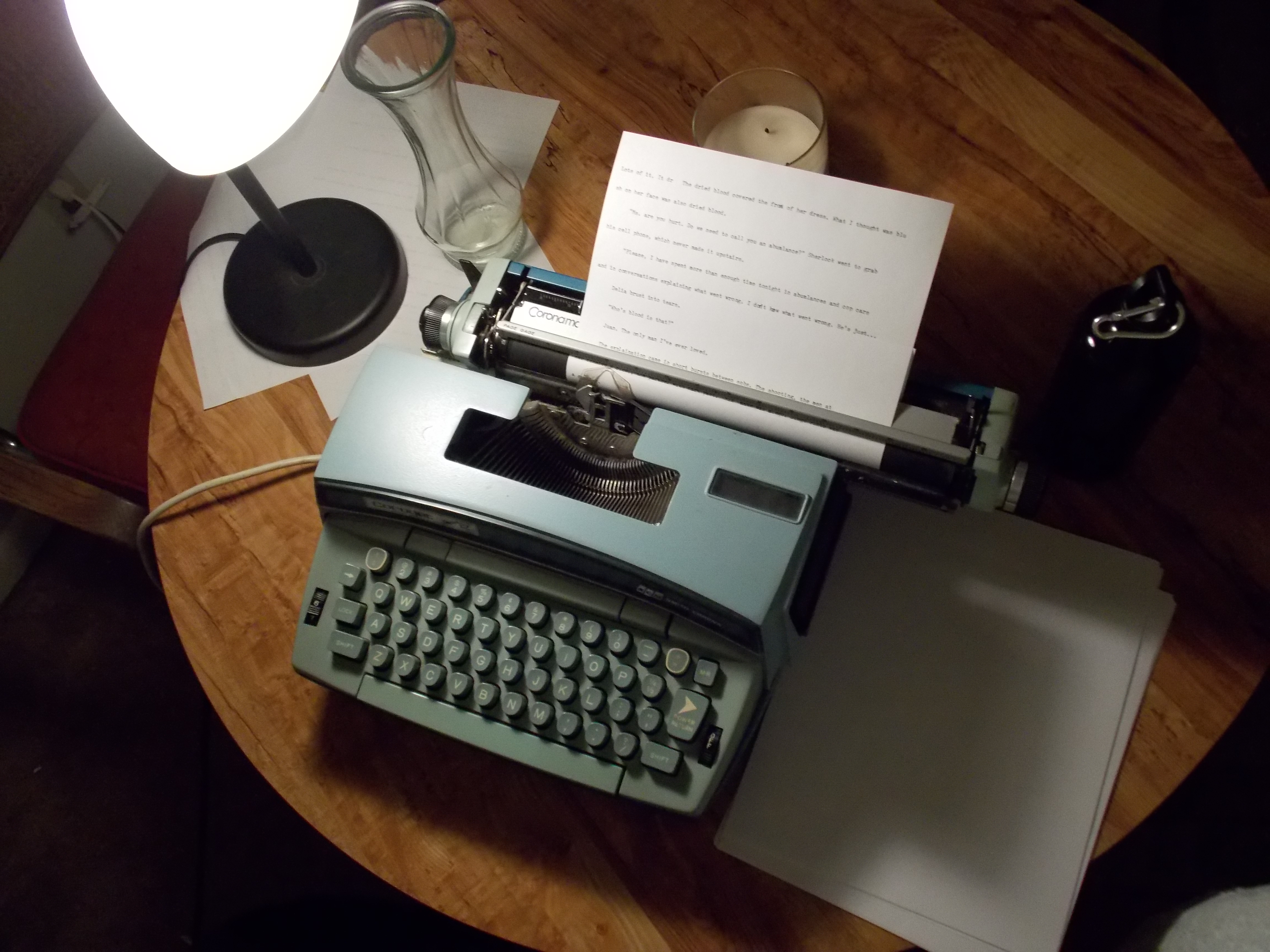
IMAG0401

Sometimes, you gotta take the plunge just to see if things work.

At least that what I told myself the night before getting the first chapter of the Jennie Manning book critiqued. I wasn’t going to do it. I came home Friday night from work and dinner with a friend exhausted and with my body asking, pleading, for quality sleep time. But, around midnight, I said what the heck.

Continue reading “3 writing tips from published mystery writers”

Spring: The best time for writing resolutions

picjumbo.com_HNCK4046
Starting the spring with a writing plan is a perfect way to rededicate yourself to your writing

Sometimes, I should just take my own advice.

The last couple of months trying to write and finish (finally!) the latest Jennie Manning novel has been a practice in patience and frustration and faith.

Continue reading “Spring: The best time for writing resolutions”

Things I’ve learned about revision so far

Editing, revision, writing, lessons, manuscriptYou haven’t lived until you are revising a story for the uptenth time in the back of a double deck bus with a deadline two hours away.

And there’s no wifi. Even though there was promise of it.

I recently took a more than year old short story and decided to give it a old college try for some publications I was looking at. As I’ve written before, revision isn’t my bag but it was something that I wanted to work on this year in my writing.

What I’ve learned so far is that everyone has their own way of revising. After talking with a couple of writer friends quickly about their process, I’ve come to the conclusion that…I’m kinda on my own with figuring stuff out.Continue reading “Things I’ve learned about revision so far”

Revising resolutions. This writer’s worst nightmare.

DSCN0253

New year, new goals and new you right?

This is the year I say no to all that.

It seems kind of funny doesn’t it? The fact that I am usually the one who start with the rhetoric of little or no resolutions.

I usually don’t have them for my writing publicly but secretly, I do. I aim to finish a book or a story or to publish.  But that hasn’t helped with my goals at all. In fact, it’s perpetuated a problem I’ve suspected I’ve had for a long time.

I confess, I’m a serial manuscripter.

This is a thing, folks. It is a thing because I am sitting here in front of you tell you this: I have no less than THREE manuscripts in my possession right now. Yes, three.

I finished the first one in February 2008. It’s a horrible piece of garbage.

I finished my second one as my thesis for my MFA program. I loved it when I was working on it. Love it still.

I finished my last manuscript two years ago for NaNoWriMo. I actually completed the thing — beginning, middle, end. No filler. No nothing. The hard way.

I’m just about finished with my latest manuscript, the first Jennie Manning novel.

Okay, so I lied. It’s four. I have about four manuscripts and not one have been through the revision process with any consistency. Why?

I’m not sure I know how to revise a manuscript into a novel.

Yes, me with this fancy MFA and all these years of writing. My revision process sucks.

Here’s what I know — I revise the big stuff first, plot holes, character inconsistencies, etc., until it’s right. Then it’s the word tweaking — diction, tone, figurative language — that is if you haven’t done it already. Then it’s the smaller stuff, the stuff that makes my eyes bleed — grammar, mechanics, etc.

Maybe it’s my journalism kicking in but once I’m done with a manuscript, I’m done. I really don’t want to revisit it. Or maybe I’m lazy or maybe I just like the creative side or maybe I just don’t know what I’m doing. Whatever it is, it has to stop.

So, my non-resolution/resolution is to finally learn to revise and to do it properly.

Now, here’s the second part of this thought. How do I do this?  Anyone have any ideas?

What does it mean to have a writing legacy?

100 years of solitude legacy


Did I ever tell you that my dad couldn’t read?

It seems odd doesn’t it? That in the modern age there are still people on this Earth who can’t read words or recognize letter. And it wasn’t that my Cuban dad didn’t know the English words. He didn’t know the Spanish ones either.

The third oldest of 8 children and the oldest of the ones that survived, he reached fourth grade and was surprisingly absent the day when they taught letters in and how to sign one’s name. My dad couldn’t write either. His signature was a loopy and stretched collection of nonsense.

His story is the typical one through out Latin America; he left school to work. He helped my grandmother wash clothes for money, learned to cook and clean and take care of a household, and at one time, cut sugar cane in the fields.

When dad escaped Fidel’s Cuba for Spain, in the early to mid 60s, he learned how to be a cook for the tourists. That’s how he earned his keep. Spain, he said, made him a man. He was so enamored with Spain and learned so many things there that he went back a couple of times after he moved to the States. And during one of those times (although, I couldn’t tell you what year) he brought back at book.  An important book.

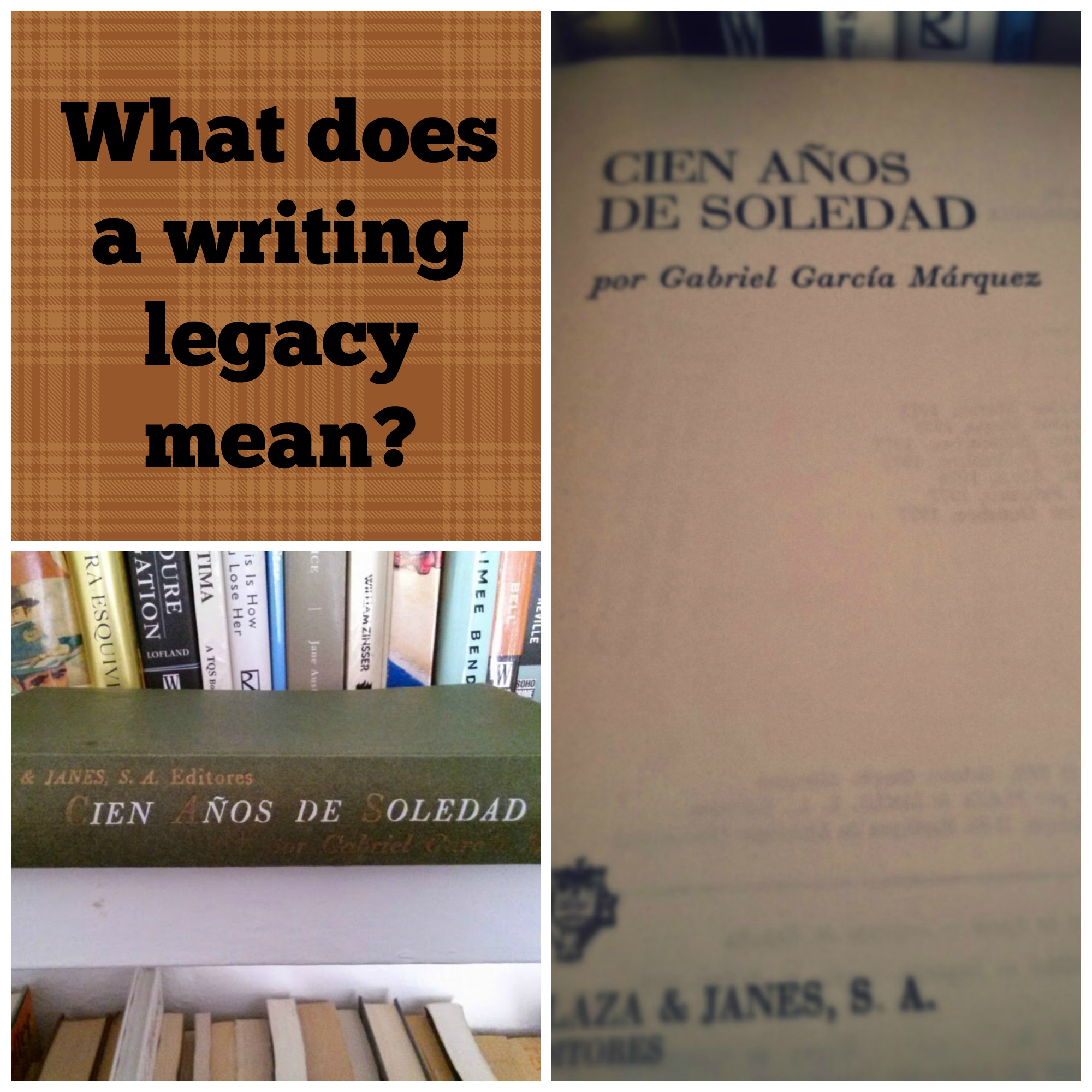
A hardback, early edition of One Hundred Years of  Solitude in Spanish.

This from a man who couldn’t sign his own name.

Fast forward many years and his daughter is now a writer practicing in the language he could barely speak. She gravitates to one of the world’s best practitioners in storytelling, Gabriel Garcia Marquez. Upon his death, she is given this book, wrapped in newspaper.

It was one of those times that I was truly breathless and speechless. I didn’t know dad had this book or when he brought it back, however, when my mom, the woman who taught me how to read, gave it to me in the years after dad died, I was overwhelmed by it.

I consider that book, with its deep green cover and too thin pages, my father’s writing legacy to me. Mr. Fernandez didn’t know much about letters or words on a page but he knew how to tell a good story. He knew about character and plot and structure as if it was part of his DNA. There is a rhythm to storytelling, something in the ear and in the heart that is seamless, like an unaltered piece of cloth. It was effortless the way that man told a story. In this way, my dad was like Garcia Marquez.

It shouldn’t be a surprise that I’ve dedicated my life to telling stories — fiction and nonfiction — and that now I help others do the same.

Legacies came in many different ways and each are special in their own right. Mine are within the pages of books, imprinted on newsprint, and in the megapixels on screens around the world. From a matchbox apartment in Havana, Cuba to a worldwide readership, his legacy is my inheritance  — all words and the stories they fuel.

Dear Reader: Lessons learned while not writing

Dear Reader (1)

Dear Reader,

It’s a beautiful fall like mid-morning in North Texas and sitting behind this keyboard while listening to relaxing music is heaven. I haven’t felt this good in a long time.

It’s been a while since I’ve written and updated you on my goings-on. It’s been a rocky four months in my writing life but what’s the writing life without a couple of bumpy patches?

I’m not going to spend tons of time in this letter discussing about the rough patch. I want to write about what I’m doing to get over the rough patch. Writers go through times — hours, days, months, years — where, frankly, it just sucks to be a writer.  For me, it came in the middle of a creative spurt where one day I was writing and the next day I wasn’t. Just didn’t want to write anymore.

Some would call that writer’s block. It’s not. Writer’s block doesn’t exist. I knew exactly what the book was supposed to look like. It was outlined. The ending was already written. I just one day wanted to stop writing…everything. The book, freelance pieces, even blog posts were not being written.

As you know, I’m truthful about my process — the good, the bad, and the very ugly. The very ugly turned its ugly head. I became depressed and thought that this was it, I was done writing. Writing would never happen again for me. All the doubts that a writer needs to lock away in order to do work seeped into my head: You’re talentless. Why do you spend so much time writing if you haven’t published one novel yet.  If you were really any good, you’d be on the third book already. Your grad school classmates are publishing, what are you doing? 

For awhile I believed it. So much so that I sank into a deeper depression and even reading was painful. It was painful to write and not to write. Friends told me to give myself time, that I needed time to become accustomed to my new life and surroundings. So that’s what I did. I focused on work, which, ironically, included critiquing student’s writing. I felt disingenuous, however — a writer who wasn’t writing commenting on writing. I hate that feeling.

But you know, sometimes, you just have to get out of your own way. Sometimes the not writing is trying to tell you something about the writing. (Tweet this)

And fake it until you make it is actually a thing.

Slowly, I began to feel less disingenuous with my critiques. I thought about my writing life as that, a life, not just a thing but an actual life that was meant to be lived. And so, I started to look for things where I can live my life. I returned to the practice of yoga, but this time more formally by signing up for a yoga retreat and attending yoga classes.  (My body is so sore at the moment! )

Then, on recommendation of a mentor, I started looking for a writing home, a critique group or workshop to join. A community. I’ve written about how writers need community but I had forgotten my own advice. (It happens.)


Soon, I began to take solace in my students. I may not have been writing but they needed what I had learned so far. And sometimes they made me laugh.

Flawless

Then yesterday something wonderful happened.

writing

Am I back to full form? No. I still have to work on the life part of the writing life. I still have to work on living. I plan to join one of the two writing groups I visited recently. Yoga will continue to kick my arse and I will use that practice to learn what I need for my writing practice — patience, challenge, acceptance, and process.

We had this saying in grad school, trust the process. By the end of our time at Goddard, it had been repeated to us so often we made a drinking game out of it. But those three words are as true as the words I love you. Trust the process. The journey is unique to each individual. That’s what makes it so precious. Trust your process, dear Readers. Trust that the moments you are living are the seeds to future amazing effort.

Trust. Trust. Trust.

With a full and humbled heart I remain…

8ea87-signature


Feminist Noir: Does it exist?

2596516715_9f2c8002c7_b

Photo Credit: lintmachine via Compfight cc

One of the difficulties with writing the mystery novel you’ve always wanted to write, which happens to be in the noir-ish vain, is being a feminist.

Yes, I said the f-word. And yes, I know about the I’m not a feminist because movement. (Eyeroll. Don’t get me started.)

Here’s a couple of “rules” of noir. There are two types of dames in these kind of stories:

  • The femme fatal
  • The good girl

That’s it. And there’s usually a detective who is doing questionable things or is questionable himself. Note I said himself. For the most part the lead detective, a term used for the person solving the case, is a man. The good girl is too good to take seriously and the femme fatal or damsel in distress is luring the detective away from some moral good or some goal he has for the case. Quite often, this chick is the key to solving the puzzle.

The dames. They’re bad news either way.

Then, as a feminist, why do I love reading this kind of fiction? The answer: how could I not?! Everything is heightened in a noir story. The theme of good vs bad, dark vs light. The dialogue is smart, witty, and sharp. The writing is usually crisp and fun to read.  I love noir, however, as a feminist they’re have been several eyerolls.

Then here’s the big question: does feminist noir exist? And can I write it?

As much as I’d like to say that I have stumbled onto something new in the genre world, I haven’t. A quick Google search gave me several blog posts and websites about female noir, noir where the main character and/or the person solve the case was a woman. Here’s a really good one that had my attention.  Here’s another one with some great examples. 

The thing with tropes, especially with noir, is that they work. After studying Raymond Chandler, the godfather of noir, and the letters and essays he’s written about the hardboiled detective story, I know that there is a formula to it. It works because it allows people to read/consider/imagine the dark underbelly of the human condition, where the good are really good, almost saintly, and the bad are so bad it’s tragic.  This only works if there are extremes with the characterization. There’s no middle of the road here, it’s black or white.

I’m wrong, there is some gray. That’s the lead character, the detective, the crime solver. They are filled with darkness and light, and both are at war within the character. For example, the detective would never knowingly commit murder unless it was by accident or justifiable (to their moral code). The detective is a flawed hero with the emphasis on either flawed or hero. While the character can switch from flawed or hero within a second, those two attributes never occupy the same space at the same time.

Imagine if this flawed hero were a woman?

We’re seeing some of this happening in modern novels and films. The Millennium Trilogy (Girl with the Dragon Tattoo) is a prime example. The Fall (available on Netflix) easily comes to mind as a noir-ish television series with a female detective. But do these characters, can these characters, compete with Sam Spade (Dashiell Hammett) or Phillip Marlowe (Raymond Chandler)? Can mine?

Or should they compete at all?

I think female noir is still defining itself, or, more accurately, deciding whether it wants to define itself at all. I believe that noir as a literary genre is now an open session for discovery and that the what defined it in the past, what became its roots, is also what is changing it.  Because of this feminist noir or female noir can and does exist next to the more traditional offerings.

Meanwhile, I can’t resist writing about femme fatals and gritty detectives with a thirst for justice. Question is, can you guess which one is wearing the heels?