One thing I try to tell my students while I’m teaching writing — whether they are learning to write a great paragraph, essay, or story — is that the first draft needs to be messy. The messier the better. I’m talking no punctuation, spelling errors, and just a big mess. Mess = exactly what you’re supposed to do.
Folks, sometimes life throws you enough curve balls to question your sanity. This here is one of them.
I haven’t really talked about a novel-in-progress called Lagniappe. If you remember, I took a trip to Saint Louis, MO last year to research part of it. This story is about a 15 year-old black girl in Shreveport 1943 named Lola Mae. Miss Lola did something she wasn’t supposed to, what not black girl and white boy are supposed to do. Because of it, her life took a different direction literally and figuratively that made her into someone worth knowing.
Right now, the story is in a series of scenes and I’m working with a technique my grad school advisor Micheline Marcom once told me — write toward the heat. So that’s what I did.
Apparently it worked because I sent those scenes to The Writer’s Hotel in NYC and they loved them! So much so that they offered me a spot in their program. The problem is…it’s $2,500 and I don’t have the money for it.
But this is my dream. Long time readers of this blog know how long I’ve been chasing this, how close I’ve come. Here’s a shot and I’ve got to do everything in my power to take it.
I’ve started a gofundme.com site so that my friends can help me get to NYC. I’ve got the plane ticket covered and I’m working on accommodations, I just need the fee.
If you’ve never seen House of Cards on Netflix, you are missing out on a treat. And you’re also missing out on some pretty big lessons on character development.
Yes, character development. While this show is couch potato gold, it’s also writing gold. It’s not just the dialogue and the plot twists that really is worthy of its own posts but also of how the characters evolve, most especially the characters you love to hate. So, to make it easier for you, I’ve put together three writing rules I learned from my weekend watching of House of Cards. And yes, this contains no spoilers.
1.) The cause is just and everything is a means to an end.
In the basic story structure, there is the protagonist and the antagonist, the good and the bad. This means that someone wants something and someone is in their way.
What’s interesting in House of Cards is that the characters want something always and what they want escalates. The means that your action and plot points have to escalate. Today, it may be power but tomorrow it’s position, or glory, etc. This keeps the plots moving. Characters all want something and what they do and how they do it, in their mind is justified, they are aiming toward their goal. If that means people die or are destroyed, then so be it.
2.) Redemption is good
Frank and Claire Underwood, the main characters in this show, are the most despicable human beings on this planet. But somehow, I want to root for them, cheer them on in their blood thirsty quest. This is done because I, as a viewer, see pieces of humanity in them that reflect me or others I’ve known. I relate to them on a very basic level and so in my eyes they are redeemed.
This is a fantastic technique if you’re writing characters who are less than nice, several degrees less than nice. Alright, despicable. If your lead characters are the scum of humanity, they are still human and that’s how a reader is going to relate to them. The reader doesn’t have to like them but they do have to empathize with them so that they can continue to be engaged.
3.) Bad things happen to good people
I’m not saying that sometimes bad people win (they do) but what I am saying is that those secondary characters who you love may become collateral damage. In fact, it works better when it is collateral damage. Depending on what you want to show, the destruction of a loved secondary character can be used to show what one of your other characters are willing to do for what they want or it could be used as a weapon, a way to hurt another character.
I also like this as a way to clean house. If you’ve got too many characters, this technique can weed out them out. It can also open a door later in the story for the demise of another character.
There you have it. Three quick character development rules I learned this weekend from House of Cards. Did you watch it? What things did you pick up on?
There’s something about being on the later side of your 30s that makes you re-evaluate every decision you’ve ever made. That’s when you think…
“What the heck am I doing?”
That’s when that sudden feeling that those plans you made in your 20s, when everything was bright and new and shiny, has, indeed, been just hopes, not really plans.
My birthday was last week. I’m now officially closer to 40 than 30 and am wondering what the heck am I doing with my life! What the heck did I do with the beginning of it? How did I get here?
I never had a quarter life crisis; I was too busy living and working to question my role in the universe or the direction my life was taking. There was a stubborn focus at 25 that I laugh at now, a little girl spinning her wheels with a map of Narnia in her pocket. But this was how most of my friends were at that age, career focused. That was until everyone started getting married. So, marriage was like that game of musical chairs (Do kids still play that?) when we were growing up — everyone was so keen and quick to attach themselves to someone quick before the music ran out. I laughed at that. It’s not time yet, I’d say. I happily continued toward Narnia.
Then came the babies. Babies became the new marriage. Everyone had one. Some have several. Some had babies and houses. All of these precious moments in taunting unison on social media. Tick, tick, the music is about to stop and soon you’ll have nothing. It was still too early and Narnia beckoned.
So, now here we are and the music has ended. Usually this is the part of the blog post where there’s some sort of personal empowerment speech, some I’m happy being the fish-out-of-water moment. There’s none here, I’m afraid. While I don’t feel sorry or sad or even as if I wasted my Narina journey, I do feel that some of that journey was just busy work.
If 30 is the new 20 then 40 should be the new 30? I hope not. Forty should just be 40, wise and intelligent and in a position to laugh at the 20/30 year-olds with a twinkle and a glass of Riesling. I want there to be a sense of security at 40 that I thought I’d get at 30 and that the lessons from so much wheel spinning and work come to fruition. I’m looking forward to that.
Direction? What the heck is that? I’ve thrown my map to Narina away a long time ago and decided not to play that game of musical chairs. Not that that decision hasn’t come with some heart break but it’s come with more wisdom than pain.
Humans yearn to live the life worth living, what ever they think that is. However, that is the question they’ll spend a lifetime answering is what exactly that will look like. At this point, dear readers, I can’t tell you what it looks like but I can tell you what it doesn’t and for now that’s good enough.
Meanwhile, there’s this wardrobe I need to go sort out….
I’m going to tell you, right now, to not do the thing you want to do. I know that you’ve always dreamed of doing this but really…just don’t.
Don’t write a mystery series.
Having said that and being so very bad at selling it, I am going to say I am having so much fun writing the Jennie Manning series. The second short-ish story is almost done and is scheduled to be out sometime next week. (Only those on the list will be able to read it. Not on it? Get on it!)
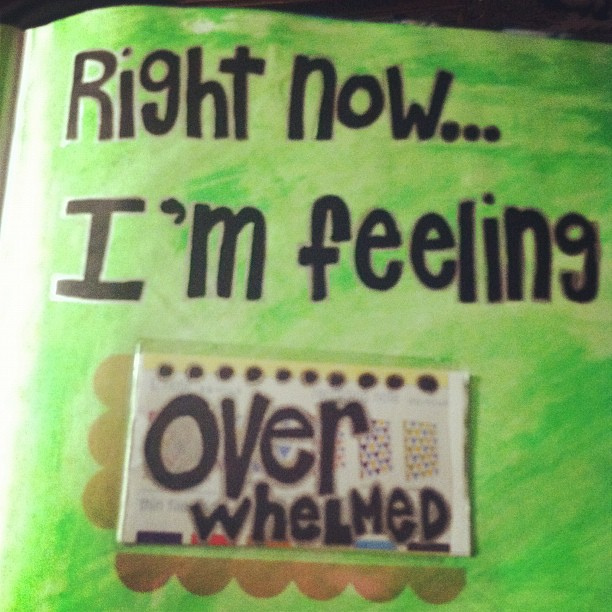
So, why the bad sell? It’s everything off the page that is overwhelming me at the moment.
With work and other obligations, I may have fallen slightly behind in the next Jennie Manning mystery story. Not that the plot hasn’t been worked out. It’s currently in a secret vault called my brain and it’s itching to come out. However, you know, life….
Photo by Elizabeth M
But I will make my deadline for the story. That is a certainty. The stress will probably get me shortly after I finish, though. I don’t know what it’s like for other people who write series but this is what it’s like for me to write one.
It’s a bit like starting a business, I think. There’s lots of worry. A long list of things to do and not enough time to do it. Lots of pre-selling to do, i.e. marketing and getting the word out that this awesome thing you’re working on exists. Little is really done on the actual story or product, which is really the only thing you really want to work on in this equation.
Yes, starting the mystery series you’ve always wanted is really starting a business and has, surprisingly, only 10 percent to do with writing. Actually, 10 percent is a really good day.
But this isn’t a complaint at all. I’m loving every minute of it. Working toward making your childhood dream a reality was harder work than I anticipated but, as with every thing, it’s about the journey and not the destination. At least, that’s what I tell myself at 3 in the morning while I’m working on all this.
Here’s what I also tell myself: If it was so easy then everyone would do it. That’s when I work harder.
Now that you know the truth do you still want to start a mystery series? If the answer is still yes, I’ll make some extra coffee for you tonight. It’s going to be a bumpy road.
Thanks HuffPo Latino Voices for this image! Kinda wish I had her hair.
As usual, I’m really bad at telling people when stuff like this happens. You would think as a communicator, I’d be better. My Twitter and Facebook followers got a good dose of this yesterday, though. And of course those on the email newsletter list were among the first to know.
I don’t look like Sofia Vergara. Guess what? Neither does Sofia Vergara.
J- Lo, Shakria, and even Katie del Castillo don’t look like what you’ve seen on TV. These are Latinas whose images we are bombarded with as standards or definitions of what Latinas should be. Sorry to tell you this but this is all myth. These are not what true Latinas bombshells are. These are just examples of how a good push up bra and the best makeup money can buy can fuel a stereotype that, frankly, we’ve lead you to believe because it’s easier to make money off of it than actually trying to debunk it.
This definition of being of a Latina is distorted at best and absolutely inaccurate. Ridiculously inaccurate. This appalling stereotype only exists because someone, somewhere, in some place in time, thought that women with Spanish surnames were the best and most exotic thing since the banana or cocoa.
Banana or cocoa. Yes, I took it there.
And now we have super Latinas. Bombshells. They sing, dance, act, and have photo shoots. That’s all great. There’s nothing wrong with that hustle. If I had that opportunity to make my money that way, I’d run to my next magazine cover shoot in my Louboutins, too. But here’s the thing…that’s not all there is to us. Never has been. There is so much more to being a Latina than you see on your movie and television screens or on magazine covers.
What is the Latina Bombshell? By the modern “definitions” she is sexy, sassy, loud, beautiful to the point of being obnoxious, sometimes sex-driven, and submissive. That’s the important part. She is submissive to “what is in her heart”, which in many interpretations is to her relationship partner.
Those qualities do not define me. Nor does it define my friends. Or the mothers of my friends.
Growing up, this was the stereotype I’ve had offered to me as a Latina woman. This was my only option because the goal was to attract life opportunities by shimmying my moneymaker in front of decision makers who would then take care of me some how. I needed to embrace it, society said. This was who I was and I already had two strikes against me — Black and Latina. I needed to use that exotic mix to get anywhere in life.
But in my mind, there was never a question of embracing that stereotype. There was always a certainty of rebelling against it.
That was the gift of two progressive Latino parents. The rule in the house with my Cuban father was always to speak up. The soft voice will get you no where. Speak up, Papa said. There’s a voice there that needs to be heard and mi’ja, people need to hear it.
Education was paired with sacrifice. Homework first, television second. College first, then marriage, if you chose that. Keep going. Always keep going. Stubbornness was called perseverance in my house. Adapt. Survive. Win.
I know I wasn’t the only one who was raised like this. This is what being Latina means to me.
So, because I rebel against this stereotype, here is what I’m offering in this blog post today, a new definition of the the Latina Bombshell.
Latina Bombshell = a woman of Latino descent with the following qualities: intelligence, opinionated, leadership, strength. The new Latina Bombshell uses failures as opportunities. She’s a hustler — driving business and commerce as easy as she can bat one of her eyelashes. There’s no apologies for being different because it’s an honor. Different means unique and being a trailblazer.
Actually, come to think of it, these characteristics sound familiar. This sounds like how I would describe my mom. And the more I think about it, the more it sounds like a lot of moms and my friends who are raising their own little bombshells.
Interesting.
Maybe the true Latina Bombshell has been there all along, we just had to get past the smoke, mirrors, and the push up bras.
Icess Fernandez Rojas is a writer, blogger, teacher, and journalist. Her commentary has appeared in The Guardian and on Huffington Post Latino Voices. Her fiction has been published in literary journals/anthologies such as Minvera Rising and Soul’s Road. Her first book, the beginning of the Jennie Manning series, will come out next year. In addition to writing, Icess teaches fiction writing classes. To learn more, sign in and receive regular emails. (No spam ever.)
I could say that I didn’t have a great childhood but I’d be lying. It was great and in retrospect, I didn’t know that growing up in east Harris County in the 1980s was anything but ideal. I do remember, however, being chastised for being different. Different hair, face, color, language. But despite it all, I had my stories.
This was how I coped with the world. I told to stories to myself in my head. In my mind I was a pop singer/lawyer/astronaut who saved the world while simultaneously having the number one record in the universe. In my mind I was She-Ra, princess of power, and in reality I was royalty but had to keep my secret identity in order to stay safe from the enemies of my people.
To say I had an over active imagination was putting it too mildly.
My dad told me stories, too. He told me about his world in Cuba, what it was like to live there and to grow up there. He told me about the time Castro paraded into Havana. He told me about escaping his home country by pretending he was two years older than he was and how my grandmother had an employer who helped with the “transfer”. There were nights my dad would tell me about hunger, and poverty, and pain – concepts my small mind couldn’t completely understand.
My mom read me stories. In fact, she was the person who taught me how to read in English and instilled in me a love of Spanish soap operas. There was the one where the poor girl was really the rich girl but the father/mother/family never knew they existed. However, the evil villainess did everything she could to stop them from knowing. Then there were my mom’s stories, filled with poverty as well but also love from a strict mother and a protective father.
I became a writer because I was raised as a storyteller.
I wish there was some sort of deep thought to this “becoming a writer” thing. Like maybe because I want to change the world through words. (I’m a journalist. I already do that.) Or maybe there is nothing else I’m capable of doing. (There’s a little bit of that but surely I am capable of doing other things. Not sure what they are, though.) There is no deeper meaning to being a writer for me than this: I love a really good story.
There’s something comforting about a story with a beginning, middle, and end, to tell someone a tale and have them interested in it. I love live readings because you can feed off the audience. They want to know what happens next and they listen, sometimes at the edge of their seat, for your next work.
I love the way stories keep us, the human race, hopeful. We know that life doesn’t always have a happy ending but our stories, most of them, have them. And they have meaning and structure and, in a weird sort of way, there is a justice there that we can’t find in our average lives. Hope. That’s what stories do, they give hope, and writers distribute that. Writers give the world hope.
So, in a weird way I am a writer because I am hopeful and believe in silver linings and wishing upon a star. I write the heartbreaks that are healed by righting the wrongs. Bad people get their just desserts. Good people walk into the sunset a different person than they were before.
And those people who were different – different hair, face, color, language – they get their happy ending, too. I make sure of it.
As for my over active imagination? Well, it’s not quite as active but still useful to me as a writer. However, it doesn’t take over my brain as it used to as a kid. Those days, unfortunately, have passed. Now, if you’ll excuse me, I have a long to do list today. I have to run off to save the world while cutting my next hit chart-topping hit.
This was the moment when I realized what paperweights were actually for.
With every story and novel, I learn something new about writing.
I guess that’s yet another reason (like I needed another) that I love writing. You are never done learning something. Today’s lesson, however, was interesting.
What do you do to balance genre and literary in one story?
Wait, what? That can be done? Absolutely, but it’s the tightest of ropes.
How I know it can be done
Once upon a time, when I was in grad school, I had to write a 20 page paper on a topic of my choice. The paper was a study in mystery fiction and whether there was a difference between genre and literary fiction.
This was a topic that was pretty interesting to think about but what a brain buster to write about when it came down to the research. See, mystery is a genre that is easy to write in, well, genre. That means that it is very plot heavy and that moves the story. It also means that it can be predictable because it has to follow certain rules. Literary fiction, however, follows different rules, not so much the rules of the kind of stories or novels it’s about. It’s heavy on the characterization and it aims to be art.
Can a mystery be both literary and genre. You betcha!
Look at Walter Mosley and Frederick Busch. Both can be considered literary for the beauty in the writing but their novels are very much genre in that it follows the rules of the mystery novel.
So, what are the rules?
The rules of the mystery genre, I feel, are known to the world. But Raymond Chandler was kind enough to write them down so that we all could glean from it. In “The Simple Art of Murder”, Chandler drops all kinds of knowledge and is sometimes sarcastic about it. One sentence stands out to me as I re-read it recently:
The murder novel has also a depressing way of minding its own business, solving its own problems and answering its own questions. There is nothing left to discuss, except whether it was well enough written to be good fiction, and the people who make up the half-million sales wouldn’t know that anyway. The detection of quality in writing is difficult enough even for those who make a career of the job, without paying too much attention to the matter of advance sales.
I don’t know about the audiences in his time but in our time, I’d like to give the reader some credit. Readers now are savvy and they know good writing, and for them good writing is what entertains them, what speaks to them, something that is good for their soul.
But, I get it. At the end of the day, the only one who really cares about the strength of the writing — whether that metaphor is on point or if that diction is correct — is the writer.
So, if the writer is worried about the quality of writing, then that quality is what makes the novel timeless.
Hemingway says somewhere that the good writer competes only with the dead. The good detective story writer (there must after all be a few) competes not only with all the unburied dead but with all the hosts of the living as well. And on almost equal terms; for it is one of the qualities of this kind of writing that the thing that makes people read it never goes out of style.
That’s a characteristic of literary writing, at least that’s what literary writers aim for. They want to write in a way that audiences years, decades, centuries from now can still read and appreciate their work. It’s a way for writers to live forever, to become immortal. For that to happen, not only does the writing have to be impeccable but it also has to touch (and comment) on a fundamental truth of humanity, which is another thing literary writing aims to do.
Then what about the genre rules?
If the writer is the only person who deeply cares for the quality of writing (according to the homie Chandler) then what about the genre aspect of the mystery/detective novel.
That belongs to the reader. Every bit of it. That is how they can relate and be entertained by the story. They know that if there is a gun in a scene, it will be used. They know by a certain time in the novel, there will be a murder, maybe two. They know there will be clues. They know that at the end, the right people will get what they deserve. And above all, they know their hero is a flawed, hot mess of a detective that is a (wo)man of honor who “talks as the man of his age talks, this is, with rude wit, a lively sense of the grotesque, a disgust for shame, and a contempt for pettiness.”
After all…
In everything that can be called art there is a quality of redemption.
How did this help me?
I think all this Chandler knowledge is going to help me most during the revision process of the latest Jennie Manning story I’m working on. There will be parts when my literary writing training is going to work best. But I also think there will be parts where my love of storytelling and of mysteries will serve me best.
After all this, I think the biggest lesson is that there is balance, like all things, and that at the end I just need to write the best story I can write.
So, that’s what I’ll do…and I’ll make the writing pretty, too.
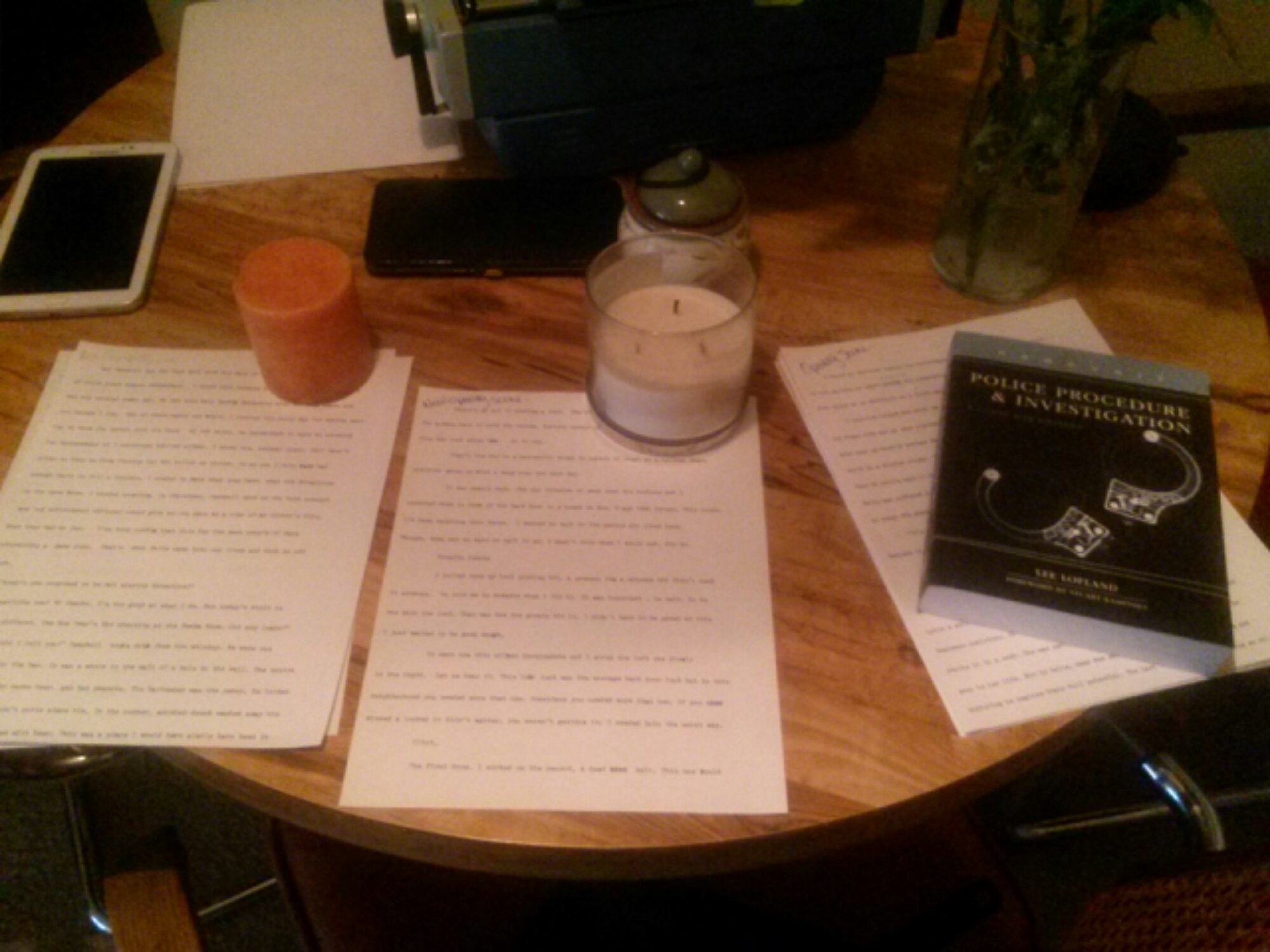
Mostly because yesterday this was my desk. Writing the next short story for the Jennie Manning Mysteries has just been…the word, I can’t find the word…awesome? Cool? Neat? No, just right. It feels just right.
You know that feeling you get when you’re writing and the words just jump out of your fingers. It’s like you think the words and they magically appear on the page. This is what happens when writing is effortless, when it’s fun.
We forget that. In a world of publishing and self publishing and marketing and such, we think about how we want our writing careers to bloom. We want to be Neil Gaiman or Zadie Smith or Alice Walker. We want acclaim to our greatness like Garcia Marquez and Isabel Allende. We want fame and fortune like that Patterson guy. We want all this and we get into this mindset of how to get there. Write. Market. Blog. Social Media. Oh, my goodness do I have to do another social media thing? What is Google +?
Really, this is what we need to keep in mind as writers: writing is fun. It really is that simple. Listen, I’ve been writing since middle school, I got my undergrad degree in a field where I had to write all the time. My graduate degree was in, wait for it, writing. And I’ve had this blog for six years and its all about, you guessed it, writing (and other things too).
But all that is nothing like the feeling of writing something you delight in and having other people delight in it as well. That’s a sexy feeling. That’s a feeling that I’d love to have everyday.
So, if you take nothing else from this post and from me as a teacher take this and share it. Writing is fun so I write to have fun.









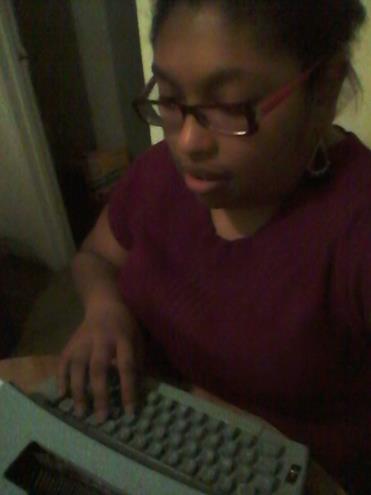 Despite it all, I always had my stories.
 I became a writer because I was raised as a storyteller.


 Icess Fernandez Rojas