World Observation #1

I am a writer.

There. I’ve written it into existence, therefore it is. But  I think we’ve all known what I am for a very long time. Sometimes, however, I have to say it or write it to make sure that it’s true. Something about believing what you see.

So let’s try this again.

I believe I am a writer.

Now that’s a statement that begins a journey. Here’s another one:

I am a storyteller.

That’s different than being a writer because where a writer is interested in things such as word counts and audience reaction, story tellers live to tell a great story.

Not that there’s anything wrong with writers and word counts, having boundaries makes you more creative. But when I tell a story, my duty isn’t to the audience or the reader, though I’m happy you’re along for the ride. When I tell a story, it’s about the characters and their reaction to the plots and circumstances I put them in.

That’s the difference between a writer and a storyteller.  In case you’re wondering.

From non-English speaking to the best practitioner

`I was always encouraged and motivated by other artists’ breaking down trails for us. The best thing about these awards is that you encourage someone you don’t even know and may never meet. I keep thinking all this will go away, and no one will remember any of it, but maybe some young immigrant girl somewhere will pick up a book someday and say, `I can do this.'”

Junot Diaz, in an article after winning the freakin’ Pulitzer Prize.


He is a man who was a boy who didn’t know English.  He grew up poor. He is the son of immigrants. He shouldn’t have had the life he has.


But Junot Diaz does. He writes the stories worth writing with the voice and depth bestowed upon age and experience. 


So not only did this man win the Pulitzer Prize, he now gets to judge them.And I’m even prouder of him. I don’t even know the cat but I do know that that quote at the top of this point, the one about a girl picking up a book, is about me. 


Yup. I’m the girl. I’m the girl he talks about. 


Thanks, Junot. 

Reading is writing and writing is reading

Thanks to @crystalposey on Twitter for posting this on her blog first.

Stephen King has given the world a book of writing advice that boils down to one thing: To write you must read.

There really to no other way around this. Really. Even my MFA program is structured so. Of course I can go into scene and squeal, a Hero’s journey, and other devices used to tell stories but what it comes down to it, it’s about face time with the page.

And there is no short cut to this either. Whether it’s on a Kindle or Nook or even just reading the book old-school style, it’s about the writers interaction with the text, what they observed and the patterns they noticed. At the end of the day, these are the best teachers when it comes to the art of writing.

So how to become, what my advisor calls, an apprentice to books? How to surrender yourself to them? Simple, you just do. You just pick up a book, open it up and with a pencil in hand underline what stirs you, what jumps out. And then study. Why did that jump out. How did the author do it? Why did they do it right there. This is where learning happens, where craft meets execution. Thats when you go from just someone who writes as a hobby to someone who practices the art.

But it all starts with reading. And then writing. And then reading some more.

Yes, it IS that simple.

And like Mr. King said, one day you will run across a book so badly written you’ll say to yourself “I can’t believe this was published.”  That’s when you realize the difference between art and commerce.

But that’s a whole other discussion for a whole other post.

Be nice to a grad student day!

Hallmark doesn’t make cards for this and I’m not sure that it’s an actual holiday since I just did a Google search for it and nothing came up.

I think there should be a be nice to a graduate student day.

As a grad student myself, our lives are constantly full of turmoil. We cancel dinners, and outings and such to do homework until the wee hours of the morning.  Then we get up and go to work for a full eight hours.

What falls through the cracks…everything needed to just have a comfortable life like clean dishes and clothes,  food in the pantry, and general errands that have dropped so low on the to-do list they’re collecting dusty.

But I digress.

I think there should be a Be Nice To A Grad Student Day.  And I think we should establish it. May 26 should be that day. Why? Cause it’s far enough away from Mother’s and Father’s Day AND around the time that most semesters (except mine) are just about done. That’s when grad students an begin taking in some air but they’re still too tired to do the work themselves yet.

So help me out with is AWESOME new day. Be Nice to a Grad Student Day, it’s gonna be a thing!

Dreams are like a shiny new penny.

I know that comparison is a cliche. I’m full of them lately but hear me out.

A new shiny penny has promise. The penny is small in size and by its self it’s insignificant but add to 99 other pennies and it’s a whole dollar.

But they tend to rusty, get dull and even tired looking. Haggard.

Dreams are like pennies.

They start off shiny and new. Bright and perky. They have an us-against-the-world feel like nothing can blemish it.

But then reality sets in. Work. Responsibilities. You’re tired. You’re busy. And that dream that you had just keeps getting duller and duller.

Even though that dream is dull and rusted now, just like that penny, it’s still usable. Even with the rust, the outline of that shiny penny is still there. The only difference is that it’s aged.

So think about that the next time your dream has “rusted”.  Dream on, folks!

Debating the merits of blogs

A semi-heated discussion with an editor one time came with the phrase about news being “wasted in a blog”.

That phrase is quite offensive for bloggers like myself. Though I am a journalist, I think there is a place where bloggers and news folk can live in peace and harmony. Saying something was wasted on a blog doesn’t go toward that purpose.

How people get their news now-a-days is varied. In the news profession, those who don’t become flexible will not have a chance to stay in the news profession, so why all this hostility?

I think that its the fear of the blogger getting where the reporters use to be, that fundamental kernel of news gathering, what draws in readers and such. Bloggers, because they don’t have the confines of daily deadlines and editors and way too much protocol can spend a morning working on a post. It may only be a couple of words but those 600 words are, in most cases, more effective than the 20 inches a newspaper can promise and delivers.

More people are also turning to blogs, even if they belong to the media organization, for an insight that can’t be read or seen through the traditional media. They want and yearn and CRAVE for people who know what they are talking about bloggers, true bloggers, provide that. They are, have become, and will continue to be the reporters on record.  Mainstream media have stepped away from that, bloggers have picked it up.

I understand that there are those folk, my colleagues in reporting, who are upset and don’t understand blogs, bloggers, and blogging. They lash out and say things that don’t make sense like “wasted on a blog”.  Though that is disrespectful to me, I’ve built a bridge and gotten over it.  Because I know, I have learned so much in my years a blogger and have developed more skills in the medium than I have in a long while. I think both blogging and reporting compliment each other perfectly and separating them both is ridiculous and ignorant, frankly.

But then again, they’ll probably be asking me for a job in a few years so…things being “wasted on a blog” is a bad way to start a job interview. Just saying.

To Lit or Not to Lit

I’ve been thinking a lot about what kind of writing I want to do and the writer I want to be lately. It’s been plaguing me since I got a response back from my advisor on my second packet.

See, it’s hard for me to let someone into my writing process. It’s my process after all and the decisions I made on day one is not the decision I keep on day 29. So having to send a story I wrote in progress to my advisor is weird. And it’s also stressful. Because of that said involvement I rush to finish stories. To get them done and as polished as possible. In that rush the elements of storytelling give way to rush writing. Not a good mix.

And of course, had those stories been genre, it’s been easier to write. Why? I don’t second guess myself wondering if what I put on the page is literary enough. Is it? Don’t know. Should I insert an extended metaphor here? If I say some thing is like something else does it mean that I’m really saying that it is that thing or similar to that thing?

Too many questions. The only questions I want to ask myself through the process are about characters and motivation. Plot. Twists.

That’s probably why I’m starting to like genre better. It’s about story, man. Do I really care about the wispy trees in the scene? Only if it adds to the story. If it’s there to make pretty words, I’m not about that.

So at the end of all this turmoil in my writer’s psyche here’s the solution…

Who cares?

That’s what I’ve come up with for an answer. Who cares? I like writing. I should just write. And then that when I realized the pit fall of MFA programs…sometimes they suck the joy out of writing. I understand why. The concern. The involvement in the process. It’s enough to strip anyone of joy.

How to combat that? Just write. It is what it is. Not everyone is going to like what I write but I can listen to the comments and try new things and maybe it end up being a better story.

After all, it IS me at the controls. I decide the keystrokes. Everything else is just suggestions.

You got questions, your characters have answers

One of the most interesting professional development sessions I’ve attended as a reporter dealt with character development.

Yes, character development in the writing of non-fiction text.

Intrigued, I attended this session. One of the best decisions I have made as a writer.

The session leader took out his wallet and showed us what was in it (except for the money of course). There was a gym membership card, the discount card to the local grocery store, his license, pictures of his family, his work I.D., and business cards.

The contents of his black leather wallet were boring to say the least but they spoke to who he was–a working family man who likes to keep trim. And that was the point. The wallet, a personal artifact, told me more about him, what was important to him, and who he was than a ten minute conversation.

That is characterization, the apex to telling a good story.

No doubt that good stories are driven by interesting characters. I don’t have if you have the best plot in the world, if the characters can’t interact with it, if they aren’t interesting…what’s the point?

One of the techniques that has helped me as a writer and a journalist is the character interview. It’s the best way I’ve found to get down to the heart of the character, their motivation and their story.

But what to ask? Here are some articles with some interesting questions to ask. In general you want to ask questions that will reveal something. Open ended is best. I think the best interview include the reaction to the questions. For example, does the character grimace when you ask about certain topics? Does the character smile and a serious question? Does the character even answer the question. Remember, what is not said is just as important as what is said to get to know the character.

Here’s something from my interview with my character Jennie Manning. Manning was a detective with the Reno Police Department who recently returned home to Houston. I interviewed her when I was stuck on her story. This unstuck me quickly.

What brought you back to Houston?


 She slumped down again and began playing with the necklace around her neck while looking at one of the corners of the room. Her lips pouted. She sat there in silence for awhile before answering.


“I wanted to be a good sister.”


How so?


Her pair of chestnut eyes looked directly into mine as if beaming a laser from them. Jennie stopped playing with the medallion, the gold chain in mind motion. 


“To catch my sister’s killer.”

Here are some other interesting links that talk about character interviewing. The bottom three have sample questions.

Happy interviewing!

http://character-development.suite101.com/article.cfm/interview_characters_to_discover_their_motives

http://character-development.suite101.com/article.cfm/add_depth_to_stories_by_interviewing_characters

http://www.autocrit.com/websitepublisher/articles/73/1/Four-Methods-For-Interviewing-Characters/Page1.html

http://thesebeautifulscars.tripod.com/interview.html

http://www.poewar.com/10-days-of-character-building-character-bio-sheets/

Meet my murder board

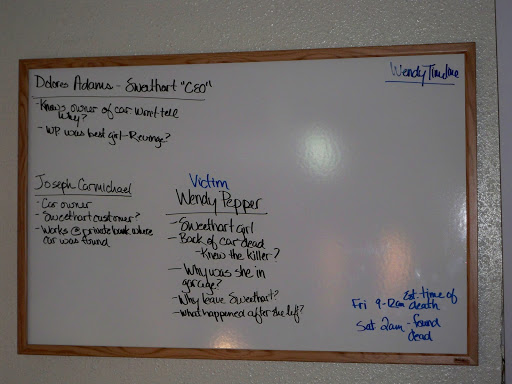
Behold the infamous murder board, or clue board, or whatever.

If you’re a fan of Castle, you’ve send something similar (better actually and bigger). Beckett likes to stare at it to look for answers. Castle has a high tech one.

Me, I have this nice dry erase board next to my desk.

So this is how I plot my murders. Don’t be alarmed. I keep them to the page. I find blood messy.

Anyway, this is for a short story I’m working on that introduces my detective character  Jennie Manning and her sidekick Sherlock. Yes, I named him after Sir Doyle’s man. It was either that or Alfred. Sherlock was more fun.

So this is what the case is so far. In case your wondering, I’m not giving away any thing away. I don’t even know who the killer is yet and how he or she will be caught, if they are caught.  *grin*

Let’s go through the parts of a murder board shall we?  In the middle is the victim with details we know about her. Don’t have physical description up there yet. Usually pictures take care of that but I may not have the space this time.

Then around the victim, I’ll have suspects and/or players in the case.  Under their names I write how they’re connected and what we know about them so far.  As you can see there is space for me to write more names and details as I continue writing the story.

Right hand side is the infamous timeline. Just like how Beckett and Castle work the case backwards…same concept. If the victim was killed at a certain time or place, recreating the last days and hours helps with flow of the story and believability. If your victim was killed at 4 am and the blood is already thickening, she wasn’t killed at 3:30, etc.

In the story, my character will have a similar board but here will be cooler, I promise.

And for the record, I was using murder boards before Castle (just so there isn’t any confusion later. he,he.)

So there you have it. A piece of my process as a fledging mystery writer.  Hope this helps some of y’all.

Happy writing!

Am I ready for an MFA program?

I got a question from a friend on Twitter the other day that I thought would make a wonderful blog post.

She wanted to go get her MFA and wondered what I thought.

Well, I gave her some suggestions that were kinda harsh but true. Getting an MFA isn’t for the faint of heart, like I’m learning now and the hard way. It’s not something that you wake up thinking you should do. Not that my friend did that but she had the same questions I had when I was in her shoes several years ago.

That’s right. I said years.

Because getting an MFA shouldn’t be about the degree at all. Anyone who can fulfill requirements and meet deadlines can get a degree. An MFA is about being part of a journey. Not a way of getting from point A to B, mind you but an education of finding out how to become who you want to be.

I know this explanation is not very concrete so let me approach this way.

For me, an MFA is like the next phase in my life. I’m not getting it to earn money, or to get some sort of literary street cred (though it helps), or even to just get the degree. I’m spending an unGodly amount of money and time to do what I’ve always wanted to do.

Not that I need a degree to give me license to be writer. I write therefore I am. But there are two questions you have to ask yourself before going down this rabbit hole.

1) Why do I want to get an MFA?
Will it add something to your life? Will it make you a better person in some way? Is this part of your life goals? The answer to the why MFA question is important because purpose is more important than intent. It’s also the admission essay question.

2) Are you okay with the fact that you’ll earn a degree with no practical use and therefore will not be getting a job right away?
Or even a job doing anything creative. Let’s face it, there are only so many teaching positions in higher education and not every MFA will be an associate professor at a university teaching creative writing. You make be still at the job you hate after your degree, paying off the student loans.

Think deep and hard about this cause this degree and especially my program, is a life changer. Good or bad will depend on you.

It took me six years before I even applied, with several lists of schools. Lots of interviewing and questions were involved in my search. Questions of myself and of the program, it’s professors and it’s alumni.

I’m glad I took my time. I adore my program and I know that my decision was sold, not done in haste, and what I wanted at the time I wanted.

Good luck everyone!