The view from my desk…well, one of them

A writer’s desk is like a home base. Sometimes it doubles as a kitchen table or an entertainment system. Despite it being a multi-tasking alter, a writer’s desk has lots of personality.

I am lucky enough to have two.

I guess it depends on what your definition of lucky is. I am a reporter at a newspaper in Louisiana so I have a desk there. And there there is my desk at home. Both look like a tornado ravaged it. Papers are everywhere. Books are stacked up high and my latest article or short story or novel has completely taken over any left over desk space.

So I thought I would share occasional pictures of my writing desks because, and let’s face it, they are a metaphor for my life right now.

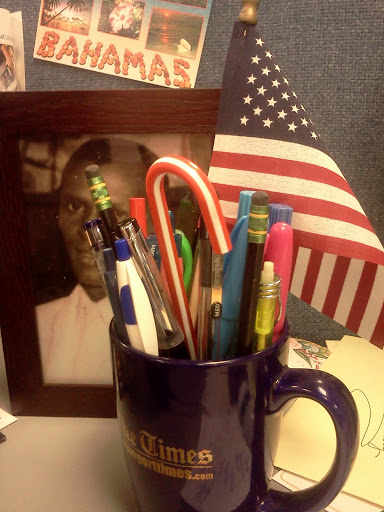
Today’s is pretty tame. A picture of my pen cup at work, with an American flag that I got from a recent story assignment, a picture of my dad, and a postcard from my recent trip to the Bahamas.

Enjoy the window into my soul.

Down the Soul’s Road

I have been holding on to a tidbit of information that I haven’t shared with the entire world yet. Well, my Twitter family knows. And my co-workers know. And I think I told my sister.

Okay, I just haven’t blogged about it.

I have a short story coming out as part of a collection called Soul’s Road. The book will be out soon and is written by my fellow Goddard students. In fact, all of the authors and even the person who wrote introduction, have ties to Goddard College. Cody Luff, an alum and good friend (and AMAZING writer. Sweet Jesus!) is the editor of the collection.

I’m excited about this. This is good. So why haven’t I shared this info on my writing blog? I think it’s really a bit of tunnel vision. My focus is school and getting packets done. So I got my story for the anthology done in between packet work. After that was off my plate, it was vacation time. That’s when I found out, when I was waiting for a plane to return from vacay. But then I was too tired and my deadline for the story wasn’t until the next month.

Not an excuse but an explanation.

Now that school is almost over and the deadline for the short is near, I’m thinking about this awesomeness that is this project and how lucky I am to be included in this. Who am I to even be considered for this?

But who am I not to be? That really should be the question. I have been a story teller nearly all my life and I’m still refining my craft, working on technique, creating stories, and observing the world. And that’s what this collection is about– observing the world, writing the truth through art.

Sound familiar?

I am darn goosh lucky to be part of this. The writers in the collection are heavy hitters and craft masters. They know and understand their art and they tell their stories, their truth, as they see it.

It’s gonna be a great collection. I’ll give you a heads up on publishing dates. But for now, like the Facebook page for more details.

Write on!

The Writing Process: An exercise in characters

So here’s an exercise that will help you learn about your character or at least help you create a new one. 
I saw this picture from Life of these four girls playing in a wind storm. They look happy, as if the time of their lives was this very moment. What is in a picture? What can be determined about life and it’s truth from what we see? 
When writing, one of the most important things I do is question my characters, who they are, what they want, how did they get there? Yes, it’s the motivation that drives the character, the thirst for the goal. But what about things that are not as abstract, things that tell me more about the character than just their goal of world domination or winning the pageant?
That’s when things like pictures come in handy. A picture like the one above is perfect because it creates a moment. In this moment, everything from body language to expression tells the truth about what is going on. What is the truth behind this moment? I argue that that is where the story truly begins. 
So let’s take this exercise a bit further. What else can tell us about these four young girls and about who they are and what they want? Where are they safe to be true to themselves? 
How about their bedrooms? 
What type of things could you find there? Do they share a room with someone? What does the space under the bed look like? Or do they sleep on the floor? Where do they keep their clothes? If they wanted to keep something private and special in a place that was public, where would it be and how would they safe guard it. 
This is the joy of characterization. It’s more than what a character wants but why they want it and what drove them there. Could one of these little girls want world domination? Maybe. If that’s the case, what is their world like now. 
So I leave you with this piece of advice when returning to your characters, go beyond what you put on the pages. Know them inside out. Your prose will thank you. 

It’s well, you know, a tradition

My silence in the blogosphere has come with a price — brand new shiny pages. Yes my friends, my  thesis/novel is moving along nicely and will be (more like has to be) done by September. So when the leaves begin to fall, the last dot on the page will be typed and I will, with any luck, be sipping on a martini.

Why a martini instead of a glass of champagne? I guess it’s a tradition, actually. Back when I finished my first book (which now sits in a desk drawer where embarrassing things should sit) I didn’t have enough money for a bottle of bad champagne. Oddly enough, I had some gin, vermouth, and apple pucker. (Yes, I don’t know why I had these things but alas, when you’re a journalist living in the middle of the country with nothing to do you gain interesting things in your pantry.)

So then, at 11:30 in the morning after crying my eyes out, I mixed myself up a cocktail to celebrate. And since then, when I finish a book I must drink a martini…and then buy myself some nice jewelry. In fact, I have my eye on a necklace from Tiffany’s.

All this to say that I can taste a martini in my near future and a sparkly newness around my neck.

Hence my explanation for my silence online. But I hope that silence will end soon.

Hold tight everyone. We’re almost done!

10 Afro Latino writers to discover and put on your reading list

Last night, I was on the Nuestra Palabra radio show with my good friends Tony, Liana, and Bryan. We talked about being Afro Latina in America and about a recent post I wrote about being such.

It was a great time and I had a great time. Unfortunately, we didn’t get a chance to get into the list of AfroLatino writers. Liana was kind enough to expand on a list I sent her and has allowed me to post it on my blog.

I’ll admit, I’ve only read one person on this list – Evelio Grillo whose book I read at the beginning of my education as a writer many moons ago.  I will definitely check out the others on this list.

Enjoy!

Nicolas Guillen – an Afro-Cuban poet, journalist, political activist, and writer. He is best remembered as the national poet of Cuba.
  
Nancy Morejon – She discusses the mythology of the Cuban nation, and the relation of the blacks of Cuba within that nation.  She also voices the situation of women in her within her society, expressing the feminism (as well as the racial integration) of the Cuban revolution by making black women central protagonists in her poems, most notably in the widely anthologized Mujer Negra (Black Woman).
  
Quince Duncan – He is regarded as Costa Rica’s first Afro-Caribbean writer in the Spanish language. His works typically concern the Afro-caribbean population living on Costa Rica’s Caribbean coast, particularly around the city of Puerto Limón. His novels and short stories have been awarded Costa Rica’s Premio Nacional de Literatura and Premio Editorial Costa Rica. He has also published a novel in EnglishA Message from
Discipline: Fiction (novels/short stories)
 
Eulalia Bernard – born in 1935, represents “the historical trajectory of the experience of West Indian blacks in Costa Rica – Poetry
 
Carlos Guillermo Wilson – Black Cubena’s Thoughts (Coleccion Ebano Y Canela), Panama, Fiction (novelist/short story)
 
Virginia Brindis de Salas – was a poet of the black community of Uruguay.  Her writings made her, along with Pilar Barrios, one of the few published Uruguayan women poets.  Poetry
 
Nelson Estupiñán Bass – the renowned Afro– Ecuadorian writer, winner of national and international honors and awards for his outstanding and voluminous interpretations of African culture in the American diaspora and nominee for the Nobel Prize in Literature in 1998, died in Hershey, Pennsylvania, on March 1, 2002. In response to an invitation by Penn State University, Capital College in Middletown, Nelson and his wife, the novelist Argentina Chiriboga, traveled to that campus to give a series of lectures on Afro– Ecuadorian culture and to interact with the Hispanic community of the region.  Poetry, essay
 
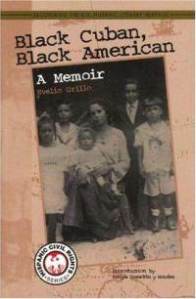
Evelio Grillo – Evelio Grillo, author of BLACK CUBAN, BLACK AMERICAN (Arte Público Press, 2000) – Memoir
 
Piri Thomas – Born Juan Pedro Tomás, of Puerto Rican and Cuban parents in New York City’s Spanish Harlem in 1928, Piri Thomas began his struggle for survival, identity, and recognition at an early age. The vicious street environment of poverty, racism, and street crime took its toll and he served seven years of nightmarish incarceration at hard labor. But, with the knowledge that he had not been born a criminal, he rose above his violent background of drugs and gang warfare, and he vowed to use his street and prison know-how to reach hard core youth and turn them away from a life of crime.  Cuba and US by way of Puerto Rico.  Memoir
 
Arturo Alfonso Schomburg (1874 – 1938) Puerto Rican historian, writer, and activist in the United States who researched and raised awareness of the great contributions that Afro-Latin Americans and Afro-Americans have made to society.  US (Puerto Rico).  Historian and general badassness with a pen.

Taking a breath. Accepting the fear.

I am tired. It’s a tired that only my week long residency can produce.  I’m toward the tail end of it now and I’m excited about the possibilities of the semester.

But this residency is different, extremely different from the last two. This is the residency where I was faced with my demons.

I knew it was coming and that this head on collision would be my test — fight or flight. I’m still making up my mind about that. So what’s the demon? What’s making me consider not continuing down this path I so longed to be a part of.

I’m afraid of succeeding.

Yes, I know it’s cliche. Extremely, textbook cliche but it’s true. I’ve talked about how I’ve come across scenes in my writing that have made me stop writing for a few days. I’ve written through the fear and I’ve written about the fear but this time, I’m not sure if the written word will cure it.

I’m afraid that after my MFA, I will be come a master storyteller. That I will be read. That people will like what I have to say and that I will do well.

I’m scared shitless and I don’t know what to do about it.

So far during my program, my writing has been compared to Garcia-Marquez, Allende, and Castillo. I’ve read twice this residency and each time my fellow students and faculty have commented on how great it was…how strong the voice is…how much they enjoyed my piece…how it would be part of a bigger piece. Each class, each assignment, each interaction with faculty reminds me how close I am to achieving my goal. It’s like smelling cookies baking in the oven. They’re almost done. I’ve started my 3 out of 4 semesters, I’m almost done.

I realized why I’m still a reporter after all these years, after the pain and experience of American journalism. Most people would have left. Most people would have found another job. I know it’s for two reasons: 1.) I’m meant to write so I’m wired a certain way 2.) Being a reporter allows me the freedom of boundaries. I don’t have to feel. Sometimes, I don’t have to care. I can plug in a formula. I can get away with not slaying the dragon.

And even with know that, the thought of leaving also scares me shitless. I can’t imagine not being in a newsroom. I love being in a newsroom. I love being a reporter when the truth comes down to it. But I also love writing, and reading. Can those two co-exist? Can I stop hiding behind the reporter cap long enough to embrace the fear and face just the possibility of being successful?

Only time will tell. And right now, that scares me too.

Third semester reading list…

For those lover of books or for those curious about what I’ll be reading this semester. Here’s the list!

Allende, Isabel, and Margaret Sayers. Peden. Island beneath the Sea: a Novel. New York: Harper, 2010. Print.
Capote, Truman. In Cold Blood: a True Account of a Multiple Murder and Its Consequences. New York: Random House, 1966. Print.
Danticat, Edwidge, ed. Haiti Noir. Consortium Book Sales & Dist, 2010. Print.
Garcia, Cristina. The Lady Matador’s Hotel: a Novel. New York: Scribner, 2010. Print.
Greene, Graham. The Power and the Glory. New York: Penguin, 2003. Print.
Kafka, Franz. The Metamorphosis. [New York]: Vanguard, 1946. Print.
Marquez, Gabriel Garcia. “Chronicle of A Death Foretold.” Collected Novellas. New York, NY: HarperPerennial, 1991. Print.
Oates, Joyce Carol. Give Me Your Heart: Tales of Mystery and Suspense. Boston [Mass.: Houghton Mifflin Harcourt, 2010. Print.
Ondaatje, Michael. Coming through Slaughter. New York: Vintage International, 1996. Print.
Pizzolatto, Nic. Galveston: a Novel. New York: Scribner, 2010. Print.
Rachman, Tom. The Imperfectionists: a Novel. New York: Dial Trade Paperbacks, 2011. Print.

I may get my brown card taken away but…

Today’s post is to set the record straight on several items that have been rattling in my brain for a longtime — my Latinaness, essentially my identity as a writer and a person.

When I started this journey three years ago to find out who I was, I should have known that part of that journey would dispel some of the theories I was conditioned accept. These theories I accepted as fact for so long.

So what’s the theory? All Latinos are created equal. Truth? They aren’t.

We are all bound by language and customs. We have the same values. Most of us are Catholics. Most of us know the sting of a chancelta.

But that is where it all ends my friends because I am AfroLatina. My skin is darker, my hair coarser, my hips wider. I am made of different stuff and that makes me different. And that has taken me more than 30 years to accept, painfully.

When it comes to other racial or ethnic groups demeaning my fellow Latinos, such as the folks at Top Gear or the folks who developed these marvels of modern technology, they are poking fun at Mexicans and their diaspora here in the U.S.  Appalling since no other group is superior to another and has no right to take their viewpoints this far. Are they jokes? Yes they are but don’t jokes turn into stereotypes which makes it harder for that group to overcome once they achieve levels of affluence?

Despite these deplorable examples of modern racism, I can’t help but feel a detachment. That’s because the same folks who are being demoralized are the same ones that give me “the look” that’s suppose to put me in my place. They are from the same country that not only doesn’t recognize that it INDEED has black people but also allows them to ONLY be housemaids on their novelas and looks at interracial marriage with disdain.

At one point in my life, I would have been outraged about the Top Gear situation as if it was about me. After all, I grew up in Houston and am considered by most folks more Mexican than Mexicans, though I am of Cuban and Guatemalan heritage. But now, I am outraged not because I am Latina but because I am a person.

You see, not all Latinos are created equal. One of our own magazines, Latina, features lighter skinned Latinas on its cover 95 percent of the time. When it does have an Afro Latina, it’s because Zoe Saldana or Christina Millian is promoting their latest project. (Zoe who plays primarily African American roles and Christina who sings pop and, if you didn’t know she was Latina, is claimed by African Americans as “one of ours.”)

How can we as a people expect folks to not make game applications about border crossings if we can’t even acknowledge our own brown folks as brown? How do you expect AfroLatinos like me to fight the good right along with our fellow brown sisters and brothers when we’re only claimed for the purposes of numbers?  When times are good, we’re made fun for our accents, our hair,  and the fact that we speak with our hands by the very people who want company in rallies and marches. We are looked at as the exotic Latinos, the exceptions not the rule. We’re Latino by circumstance and not really regarded by most as an actual brown person.

What does this have to do with writing? Tons. Part of writing is learning and figuring out who you are. Identity has fueled writers for centuries. It’s why we write what we write and sometimes the how of writing.

So yes, all Latinos are not created equal. We are barely labeled the same. I may get some negative backlash from this but I don’t care. It needed to be said and acknowledged. Sometimes ignoring the issue for the greater cause creates another cause later on.

So I want to hear from y’all. What do you think? Who disagrees? Let’s have an open discussion about this. I think it’s about time.