Two Steps to Self-Promotion In A Self-Publishing World

If you think opportunity is knocking by itself, you've got another thing coming.
If you think opportunity is knocking by itself, you’ve got another thing coming.
Editor’s Note: As I go through the process of moving, a couple of my expert (re: smarty pants) friends — experts in writing, marketing, publishing, and social media — are pitching in until I get back. Enjoy their wisdom and visit their sites, which are listed at the bottom of their post.

So you have conceptualized, developed, and written your inspired and engaging piece of prose, uploaded it onto your website or blog, and are now patiently waiting for the money and exposure to just start rolling in.

If only it were that easy!

Writers of the world are living in an age of self-publishing and that means they are living in an age of self-promotion as well. No longer do they have to rely on sending in their painstakingly crafted creations to the anonymous recipient in a publishing house, hoping and praying they will “get” and want to showcase their talents to the rest of the world.

No, writers can now take this onus onto themselves and their trusty laptop and publish their works on their own terms.

So how does one undertake this enormous task of marketing and promotion that was once left to an entire public relations department? Here’s how.
self promo1

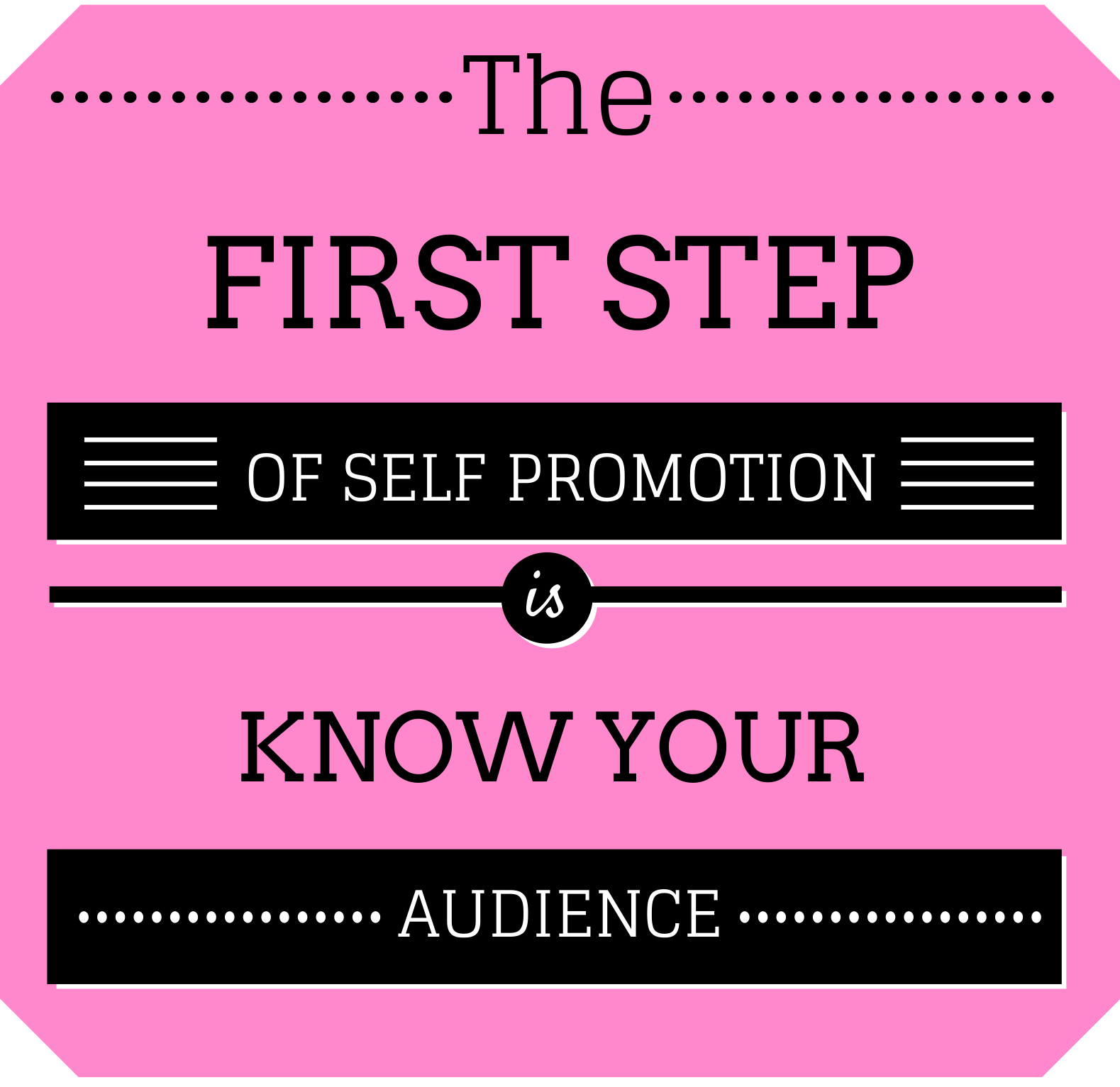
Start by researching and knowing who your target audience is and what their interests and/or concerns are. According to Susannah Breslin at Forbes Magazine, “You need to know your demo intimately. What is their gender, age, race, class, location? Are they educated, funny, stupid, smart, conservative, liberal, easily entertained, or hipster cool? Are they loners or pack hunters, seeking to be inspired or bored housewives, data junkies or tech noobs?”

Essentially what Breslin is saying is you MUST know and understand your target audience as much as you possibly can so you can use the appropriate channels, topics, issues and media outlets to effectively get your specific message out to the audience that would be most receptive and interactive with it.

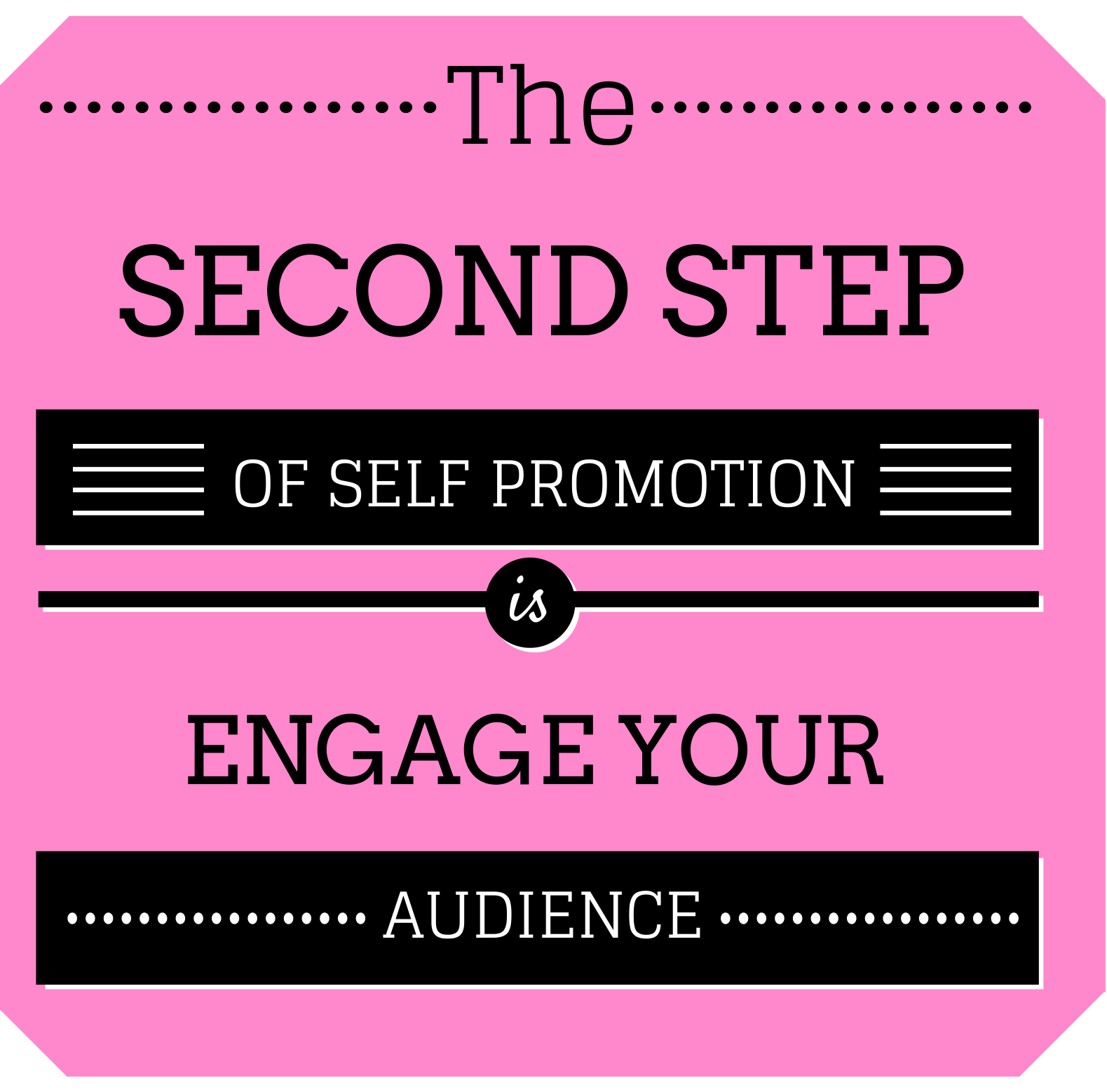
Ok, ok, I’ve figured out who my target audience is, what they like, don’t like, but how do I get my message and or blog, article, book etc. out to them? One of the easiest and most effective tools we have is right at our finger tips, content marketing via social media.
self promo2

Essentially, content marketing is a tool used to communicate with your customers and prospective readers without deliberately trying to “sell” to them. This new way of looking at marketing in direct contrast to old school methods of advertising and publicity. Target audiences can be picky and savvy with who they give their hard earned money to. They will more likely be inclined to give to those individuals who are actively “giving” them useful and engaging content rather than merely just trying to actively “sell” to them.

One of the easiest ways to engage in content marketing is through the platform of social media. For sake of brevity I will discuss what I like to call the Big 3.

big three

Facebook, Twitter and LinkedIn are all similar but very different platforms used to present and disseminate your message and/or content to your target audience. The tone, language, and content you choose must be tailored to engage and inform your audience according to the platform you use.

Facebook is more of an informative, engaging platform as there is a much more liberal word allotment and you will find that engagers will openly share their thoughts and opinions on this platform.

Twitter is much more casual and direct as you only have 140 characters to get your information out. This is where your creativity and word craftsmanship must come into play.

LinkedIn is much more business oriented. However, with all of the newly added posting and sharing functions that LinkedIn has acquired to be competitive, the formal business style can now be tempered with a more social side.

To be truly successful in managing your social media platforms, you must be open to learning and listening to your audience. After all, they are the ones you are targeting and engaging with. Be alert as to what they are discussing and engaging in. Find out what topics and current events they are passionate about. What are you doing to enrich and engage in THEIR social community?

Bottom line, content marketing through social media needs to be just that social and engaging. If you are constantly using your platform ONLY to market and advance your own agenda, you will lose your target audience; they will tune you out and go elsewhere to get their engaging content and helpful information. Give back, post interesting articles, videos, even other writers work.

Ultimately, if you aim to consistently deliver information and or content that makes your reader more intelligent and informed, they will eventually reward you with their business and loyalty, which inevitably is every self-published writer’s dream.

So, I encourage you to start scouring the internet and find that content that will inform, engage and or enrich your reader’s lives. You just may find that in order to be a successful self-published writer, you must be a successful marketed one as well.


Dina Arsenault is a public relations professional and a freelance consultant with A Cue Creative Consulting,  a boutique agency specializing in the art of branding artists and small business owners. She’s also a creative person writing, producing and directing her film short Redemption in 2007, which screened at the Reel Women International Film Festival in Los Angeles. Aresnault graduated with honors from Brock University in Communications Studies, earned a Broadcasting Diploma in Radio, TV and Film from Niagara College and most recently a public relations certificate from Simon Fraser University.

5 writing links you should read this week

TAG

It’s been a great week for writing links, let me tell ya.

Lots of great stuff out there and lots of not that great stuff out there. I try not maneuver around the bad stuff so that you get something worth reading. See, we all don’t have time to mess around. So what spend it reading bad blogs/articles?

So, here’s some of the good stuff.

Basically, this writer on Medium wrote a 101 on how to be a writer. Not sure if I agree but it makes a good read. 

So, if you’re a writer’s friend or acquaintance this much is true, you’ll end up on paper some day. But is that okay?

Wait, so kids aren’t reading James Baldwin anymore? How is THAT right?

How to market your book and strengthen your author platform using Goodreads.

Let’s be real, it’s not easy making a living as a writer. This blogger agrees and has 13 reasons on why its hard work.

Want to get more writing links during the week? I usually tweet them out, or share them on Google+. I also like putting them in my Flipboard Magazine.

Why I don’t care about pageviews…still

Yup, still don't care. What of it?
Yup, still don’t care. What of it?

So I was talking to one of my guest post writers recently when we talked about some potential blog post ideas when I said this phrase.

“Pageviews mean nothing to me.”

Since we were on the phone, I couldn’t determine what her reaction was. She’s a pr and marketing expert and had just launched her own website for her business.

I’d written about this topic before. Yes, I still use SEO techniques and I still use social media to promote the posts on this site but I very rarely look at the page view stats.

There use to be a time when I would obsess about those numbers, not only for my site but for the site of the newspaper I worked for. We did everything possible to get those numbers to pop. And I did the same for my own site. At its height, my blog would receive at least 8,000 page views a month, a very nice number when it comes to the sponsorship search or becoming a brand ambassador.

But unlike the newspaper site, I didn’t really live by that number. So, when I looked back at the posts I used to reach that 8,000 a month, I cringed.

Horrible. Those posts were so bad.

What made them that way was that they were not useful. They were created just to be click bait not to help anyone or to inspire anyone to do their best work.

And what was I doing if I wasn’t helping people?

That’s when I decided that I would write things that would help people with their writing journey. Whether it was thoughts about self publishing or how to create awesome characters or  even inspiring people with my own journey through the writing process, I wanted every single post to be useful.

So I stopped looking at the stats for this site. I listen instead to the conversations I have to people on Twitter or Google+. I listen to other writers and offer advice or support. Then I write that up for this site. I bare a bit of my soul and my thoughts on things and stories I’m working on.

If I don’t care about pageviews, what do I care about? The follow number — Twitter, newsletter(s), and this site.

Those numbers validate what I do and tells me if what I’m doing and writing is valuable to the folks who read them. The ultimate number is the newsletter subscriptions. Why? Because those folks not only read the blog and get it in their email box, they want to know more.

Newsletters are the only place where more is better. But more doesn’t mean amount. It means quality.

Essentially, all this is about mission statement. I want to help people get to where they are going — whether its through advice or through inspiration. Page views aren’t part of the mission.

Yes, mission. Writers need mission, a focus, if not they’ll spin their wheels and get no where.  For me, my mission is to help people on their writing path and continue my own. Anything else is just noise.

So, what your mission statement? What do you stand for? Don’t know yet? It’ll come to you soon. Until then, check in, ask questions, and of course get more with the newsletter.

How to Keep Suspense and Tension Alive in Rising Action

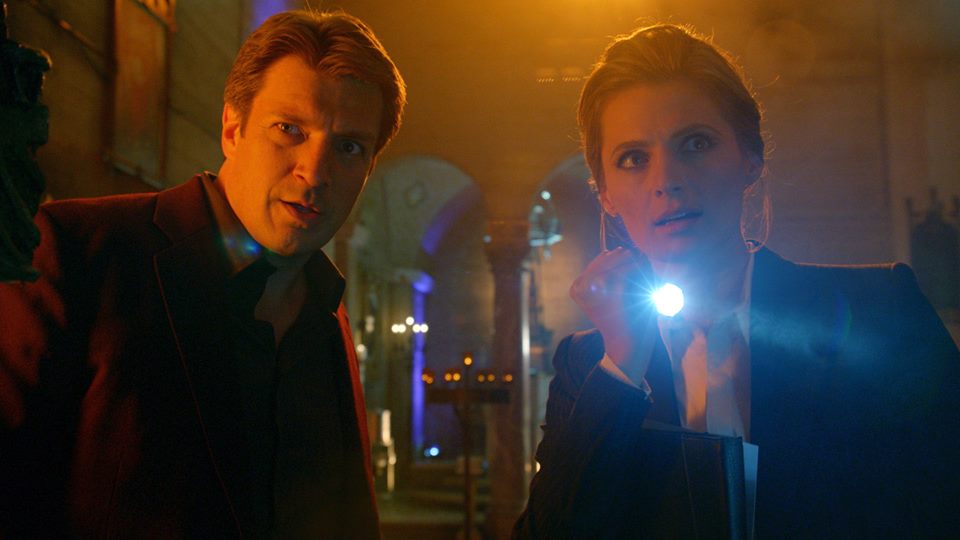
Caskett
Photo courtesy of American Broadcasting Companies, Inc.
Editor’s Note: As I go through the process of moving, a couple of my expert (re: smarty pants) friends — experts in writing, marketing, publishing, and social media — are pitching in until I get back. Enjoy their wisdom and visit their sites, which are listed at the bottom of their posts.

Okay, writers, we want to write detective fiction. Whether we readily admit to it or not, most of our ideas of detective fiction have been shaped by TV. I mean, who doesn’t like Veronica Mars, a strong and sassy, 16-year old (wise beyond her years) using her dad’s private eye resources to solve her best friend’s murder? Or (more likely if you’re a writer) Castle, a mystery novelist who shadows the NYPD as his muse?

But here’s the problem: when our ideas of detective fiction aren’t shaped by books, we have a problem writing pacing. After all, we’ve just imagined a 300-ish page novel as a 51 minute television show minus commercial breaks, so when we don’t have background music enticing people to watch slow revelation, we realize that describing every gritty detail of the crime scene is, well, boring.

But aren’t these gritty details crucial?

Review: Monk running toward the finish line
Photo courtesy of USA Networks/NBC Universal

So how do you keep suspense and tension alive in your rising action, conveying enough detail to drive the story forward without boring your readers? (HINT: You don’t always need car chases and explosions, Michael Bay.)

Let’s talk for a second about what mystery and suspense are. Wait –aren’t they the same? Nope: mystery is “who dun it” and suspense is “will it happen again?” Mystery is about figuring something out, about solving a puzzle, and what the lead character will find next. Suspense is about making sure your protagonist is always safe, it makes you wonder what will happen next to the lead character, and could be a nightmare.

Sometimes bookstores will classify these novels into two sections: there’s “Mystery” where the environment is a closed circle where no one leaves until the detective finds out who did it, and there is “Suspense” where the detective is solving the crime but his/her life is also on the line.

Does this mean that mystery and suspense need to be exclusive? Absolutely not.

In every single detective fiction story (and you might even argue in every story), you need to have suspense, because this is what keeps the reader going: to find out what is going to happen. The main character needs to fear death. Now, Aristotle argued that a character always needed to die in drama to get a cathartic reaction in the reader. That’s no longer a requirement in modern fiction, but the main character needs to at least fear death.  (By the way, death isn’t always physical, but could also be professional or psychological.) So your main character needs to fear, and when there is a murderer running around free of justice, it seems somewhat logical that your detective is trying to stay one step ahead of the murderer so that he/she isn’t the next victim.

But what does this have to do with your rising action?

The rising action is always the hardest to write. You have a motivated character, you want to solve the murderer, and everything in between needs to connect point A with point Z. Oh, and it needs to be interesting. Oh, and it needs to escalate in tension. Oh, and it needs to have a balance of detail and action. Oh, and it needs to balance dialogue and setting. Easy peasy, right?

Here are a few tips to make sure your scenes have the right pacing and keep the right suspense.

MYSTERY

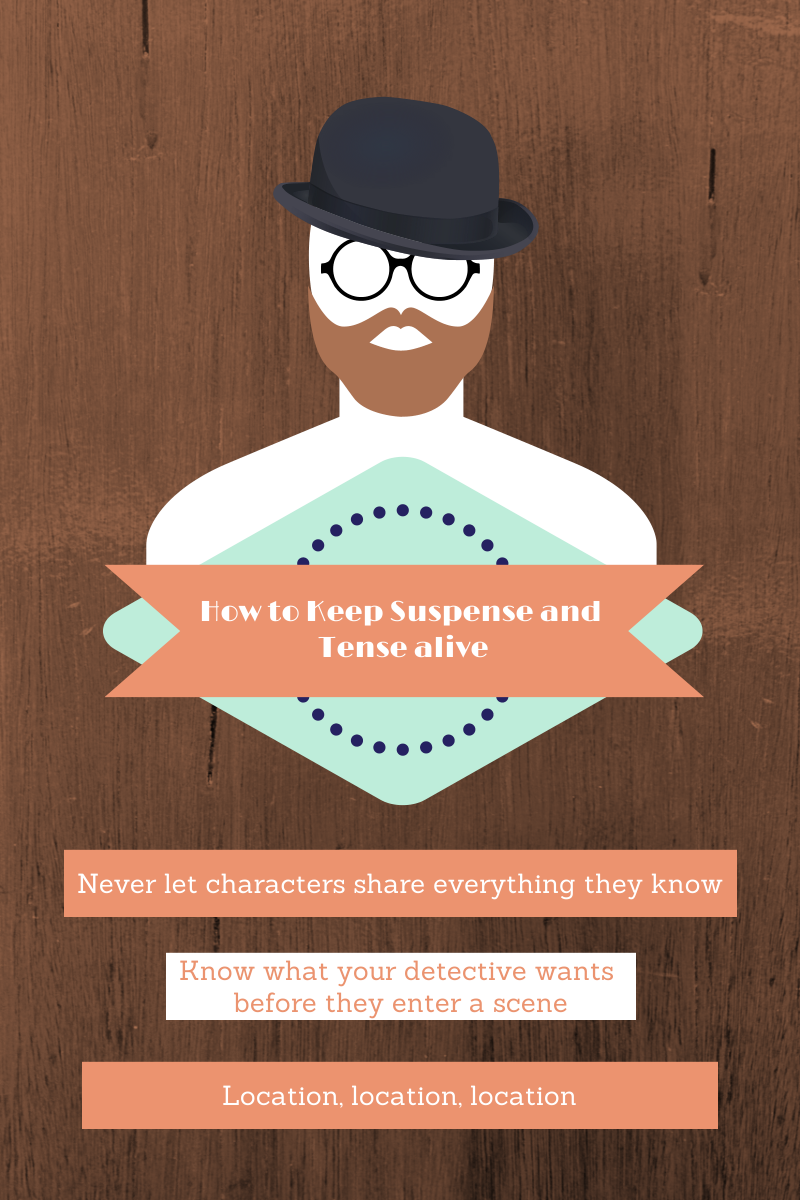
1. Never let characters share everything they know.

Real people don’t speak in monologues, real people lie, and real people have situations where they get interrupted. Also, if your key witnesses give away all of their information too fast, it kills the tension. Interrupt them. Make them lie. Keep them crafty.

2. Know what your detective wants when he/she enters a scene.

And then make the scene go differently than expected. Your characters can’t just passively show up on stage because you think you need to follow them. Start every scene knowing what he/she wants, and then make the scene go differently. Push their limits. See who they really are.

3. Location, location, location.

If you’re writing a detective drama, you’re going to go places. Make sure you never have two characters just sitting in a room talking (it flat-lines the suspense), and when your characters are “on location,” make sure those places bring something out in those characters. Also, can you change up the reader’s expectations? What if it was sunny at a funeral? What if the meeting with a mob boss was in a preschool playground? Make things happen in unexpected locations with unexpected weather, and you’ll get more interest out of those scenes.


Kristen Kauffman teaches creative writing at Yavapai College in Prescott, Arizona. She has works published as novels, essays, and poems, and for Nanowrimo last November, she started writing a detective novel. You can follow her at herwebsite, on Facebook, and on Twitter.

The writing links you need to read this week

TAG


Starting out the week with awesome links about writing and the writing life? That’s how it should be!

I typically do this on Fridays but since we’re doing things a bit differently this month, why not start with some interesting sites and info I’ve seen.

I love this group of links because not only is there information specifically for authors from sites that cater to them but also links from other kinds of sites, like the first one on the list.  Learning about writing, being a writer, and even being an indie writer, comes from several sources.

So, without further explanation, here’s the five writing links to start your week.

Want to get more writing links during the week? I usually tweet them out, or share them on Google+. I also like putting them in my Flipboard Magazine.


A tale of three book covers. Which to pick?

cover proposalsI’m packing so many boxes that I am so glad to sit down and write this blog post.  Well, sorta.

While I’m packing and getting ready to move to Texas (and working to have this website essentially function with little supervision)  I also know that I am going to return to a lot of work. One on the to do list is finishing the latest Jennie Manning story and getting into the hands of my editor (more about creating a team a la Joanna Penn in a later post).

And I have to pick a book cover!

Okay, these aren’t book covers, they are the leading images for the story, which will be just under novella length upon completion.  (I already have someone lined up to do the book cover and she is going to rock your world. I can’t wait!) So, why have images when it’s only a story? It’s about the experience.

The Jennie Manning stories are only available now to people who sign up to get it for free. These amazing folks are the first ones to read and know this character and world before the first novel of the series is sold. To me, they are royalty. They signed up and took a chance on me when there was only an idea so I always want to put my best foot forward for them and that includes the best cover I could give them.

So, which one would you pick? If you want to get a chance to vote and get the story for free, follow this link.  To learn more about the series, check it out here.

Also, the folks on the list are about to get a bit of a surprise in their inbox on Friday. Trust me. You’ll want to sign up before then!

The next start over

SONY DSC

Today is the last day of things and the beginning of other things.

I don’t want to go into too many details but I am moving from Louisiana back to Texas. I’m embarking on a new adventure and I feel  a bit like the woman in this picture — on top of a mountain looking below at everything.

The mountain is my career and below is the path I took to get to this point. I can see where the path was smooth and even and where it was the most rocky. I see the fork in the road that I wished I’d taken and the ones I was glad to experience. So many lessons, so many years and the theme to all this is simple really.

Life is a series of starts and stops, start overs but no do overs. It’s up to you to make something of each start and stop. (Click to tweet this)

So here I am, at the beginning of the next start over with paths and paths of lessons behind me. I’m excited for what’s ahead and grateful for what’s behind me now.

You should know, dear reader, that during this transition you will not be left alone.  I’m taking about a month off but this blog will be active in the month of May (while I’m packing and moving). There’s a couple of posts in the can waiting to go live. I also have some friends stopping by to guest post. Here’s some of the topics they’re writing about:

Rising action in mystery stories

  • Lessons I learned writing my first novel
  • Why writers should blog
  • Self promotion 101
  • There’s more topics but I don’t want to give everything away!

Meanwhile, I can always be reached through social media, via Twitter or Google+ and see my move through Instagram.  And of course, you’re welcomed to follow.

I’ll be back in June! See you then!

His magic was my realism

Don't quit your day job. Writing with a 9 to 5

I was talking to a lady about my desk when the world heard of his passing.

“I’m not sure my couch would fit here with my desk. I’m a writer and I need my desk.”

I said that to the woman showing me the apartment. I am moving to a bigger place, in a bigger city, in a bigger state because my career just got bigger. I’m about to work at a university and advise students who will become amazing journalist. They will report and write and distribute the news in ways that we all haven’t even thought of yet.

My phone buzzed but it usually did with emails and texts and such. It’s the burden of being connected. It buzzed again. Even as I write this now, I don’t know why I didn’t check my phone.

Gabo died and I didn’t check my phone. I didn’t check it for a long time.

Gabriel Garcia Marquez was for me a teacher. I write often on this blog about voice — how I lost it and how I gained it back. But I’ve never written about what I did to keep it, to make it grow in strength and in consistency. I mean, what are you supposed to do once you have a voice?

You’re supposed to use it.

Garcia Marquez said it was okay to use it…and often.

That’s because in my voice was me, all of me. Everything that makes me who I am and all the things I have yet to become. It’s okay if sometimes the voice goes back to childhood because I am that person. It’s perfectly fine if my voice is cold and cruel because sometimes I can be that way, too. This was who I was and it was okay to be this person.

While writers like Junot Diaz, Roberto Bolano, and Cristina Garcia helped me find my voice, Garcia Marquez made it okay to be more than one thing, fiction writer and journalist. After all, it’s the story that matters. It’s the story. Always the story.

That’s when I knew I was a storyteller, not a writer. Story drives me.

I read the messages on my phone.  I didn’t stop to react to his passing so I dismissed it as another news event.

It wasn’t until the next morning, in the quiet hours, before the world began to bark, that my heart understood the messages.

El maestro had passed. Garcia Marquez was no more physically but had crossed into a place where he was immortal, where he’d live forever in the stories he wrote. This is when I realized one fundamental thing, the last lesson he would teach me.

Storytellers live forever.

There is an indescribable hole in my soul since his passing, as if a family member in another country had passed on before I had a chance to know them, before my eyes memorized the contours of their face.  I feel his passing deeply, beyond the meaning of words, in a place where only other storytellers dwell. My bones ache with sadness and the world’s colors are duller. It will be a while before the luster returns.

It may sound silly, all this feeling for someone I’ve never met. We all pretend to know other artists through their work. For me, that’s not so. I got to know myself through his words, his imagery. His magic and was my realism. His magic nurtured my voice.

In recent years, I’ve had the great privilege of being compared to Gabo but not in the way you’d think. His mastery of story was not where the comparison was made but in the strength and clarity of voice.  At one time, that terrified me but now I know that was the legacy he left for me.

Good night, maestro. The angels await your stories.


My other posts about Garcia Marquez


Other great Gabo stuff on the interwebs


5 book and publishing links you should read now

1. How to Edit Your Book from Polly Courtney on Vimeo.


From time to time, I’ll come across a series of really interesting (cool, awesome, amazing) links about writing or self publishing that I’d like to share.  Usually, I like to share them on Twitter or Google+ but some of this stuff is too good to pass up.

1.) Discovered a series of videos from UK writer Polly Courtney on how to self publish your book professionally. (The first video of the series is at the top.) Not only do I really like how straight forward the videos are but I like that they are short and that they are pretty entertaining. To see the rest of the videos, check out her Vimeo page. 

2.) One thing I am so looking forward to once I FINALLY finish writing and publishing my book is publishing in other countries. Here’s an article that told me just how to do that. 

3.) So how do some characters express emotion? Depends on the emotion…and the character. Here’s a breakdown. 

4.) Are you posting to often on social media? Here’s how you know. 

5.) Want to turn your blog into a book? Here’s how you do that.


There you go! Happy reading!